
1.1.1 What is malnutrition and how is it measured?
In adults and older people
Malnutrition can be defined as a ‘state resulting from lack of intake or uptake of nutrition that leads to altered body composition (decreased fat free mass) and body cell mass leading to diminished physical and mental function and impaired clinical outcome from disease’.1,2 Some definitions of malnutrition include over-nutrition (overweight and obesity) as well as under-nutrition3 , but in the context of this report ‘malnutrition’ is used to mean under-nutrition and nutritional risk. Malnutrition can occur due to a number of reasons alone or in combination, and is illustrated well in the ESPEN diagnoses tree of malnutrition which depicts the different types of malnutrition based on aetiology (Figure 1.1). 2
According to ESPEN, malnutrition, or undernutrition, is characterised as a condition arising from insufficient intake or absorption of nutrients, leading to changes in body composition, including a reduction in fat-free mass and body cell mass. This condition contributes to declines in physical and mental function and is associated with worsened clinical outcomes in disease settings. Malnutrition may stem from inadequate nutrition alone or be exacerbated by catabolic processes driven by inflammation in both acute and chronic diseases.2,4
Recent international guidelines from ESPEN and GLIM have refined the definition to focus on both phenotypic and aetiologic criteria.5 Malnutrition can be classified based on its underlying aetiology, including disease-related malnutrition (DRM) with inflammation, DRM without inflammation, and malnutrition associated with starvation or inadequate food intake.5,6 GLIM criteria provide a standardised framework for diagnosing malnutrition, requiring at least one phenotypic criterion (such as non-intentional weight loss, low body mass index, or reduced muscle mass) and one etiologic criterion (such as reduced food intake or assimilation, and inflammation or disease burden) for diagnosis. 5,6
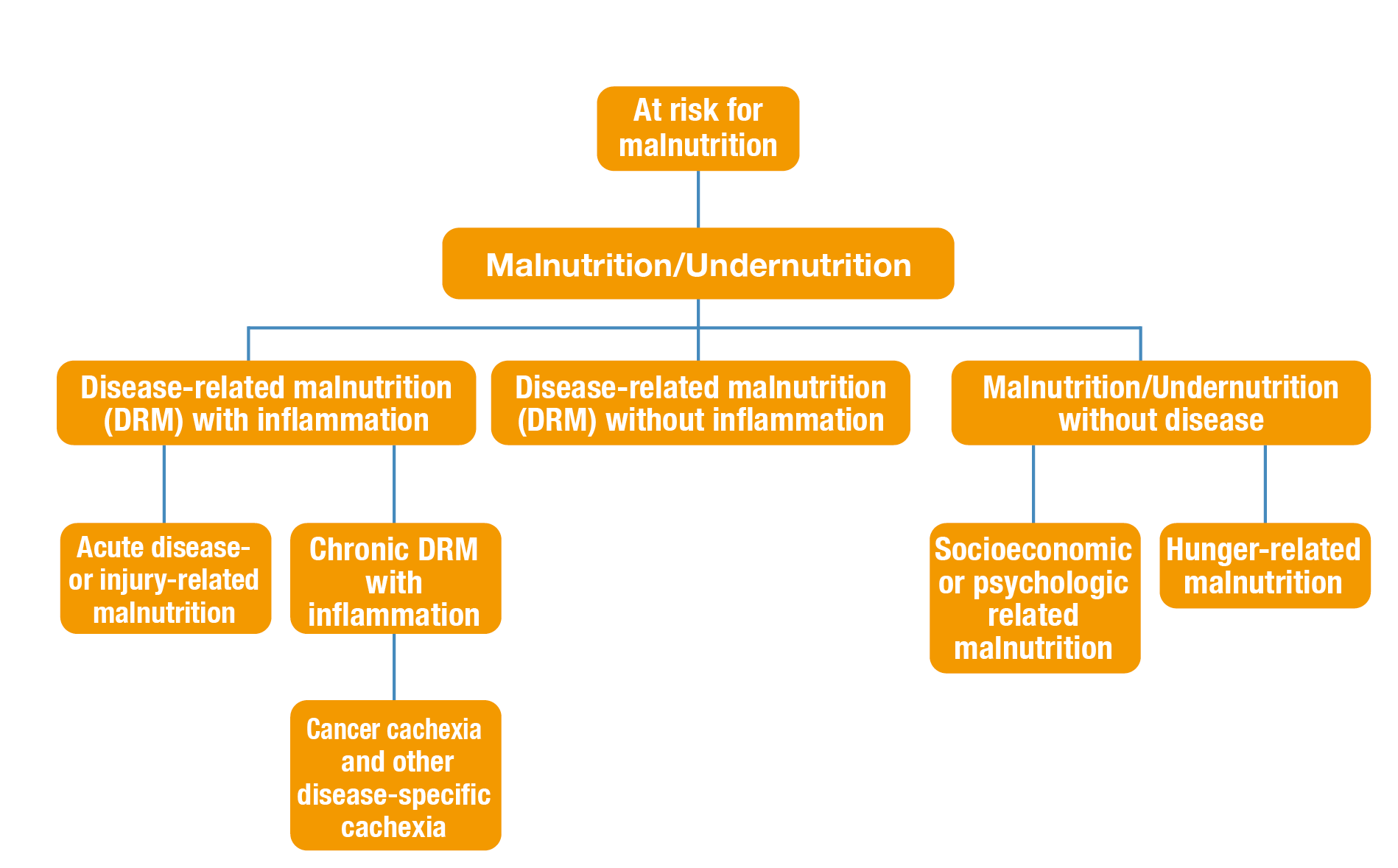
ESPEN Diagnoses tree of malnutrition (adapted from Cederholm et al. 2017)2
The presence and degree of malnutrition is established using ‘nutritional assessment’, a detailed, specific and in-depth evaluation undertaken by a competent health professional, which should be undertaken using a variety of measures and repeated at regular intervals to identify trends for an individual over time. A variety of methods of assessment are commonly used, ranging from simple ‘eyeball assessment’ to more complex measures, e.g. anthropometric or biochemical measures. No single measure should be used in isolation, and a number of important factors should be considered during nutritional assessment (see Table 1.1).2,7
GLIM uses a two-step approach, beginning with nutritional risk screening through tools such as NRS-2002, ‘MUST’, or MNA, followed by a confirmatory diagnosis using the GLIM framework which involves integrating phenotypic and etiologic criteria to establish the presence and severity of malnutrition.5,6Studies show that malnutrition diagnosed using GLIM criteria is strongly associated with poor clinical outcomes, including higher mortality, increased complications, and longer hospital stays.8-11
ESPEN recommends using different screening tools depending on the setting, such as NRS-2002 for hospitalised patients, ‘MUST’ for community settings, and MNA-SF for older adults, while PG-SGA is commonly used in oncology patients. Advanced body composition analysis methods, including bioelectrical impedance analysis (BIA), DXA scans, and muscle ultrasound, play a crucial role in assessing fat-free mass and muscle loss, which are essential indicators of malnutrition. Additionally, functional assessment tools such as walking speed, timed gait, chair stands, hand grip strength and respiratory function tests help evaluate muscle function and severity of malnutrition, particularly in older adults and critically ill patients. Laboratory markers, including albumin, prealbumin, and C-reactive protein (CRP), can assist in monitoring nutritional and inflammatory status, but they should not be used in isolation for diagnosing malnutrition. Despite the availability of multiple screening and assessment tools, no single “gold standard” exists, and a combination of approaches is recommended to ensure accurate diagnosis and effective intervention.4,12
Factors that should be considered during nutritional assessment (adapted from Thomas 2007 and Cederholm et al 2016)2;4
| Clinical considerations | Impact of acute or chronic illness, surgery or treatment, e.g. medication |
| Physical state | Physical appearance (thin, pale, loose clothing), mobility, breathlessness, poor wound healing, oedema, weight loss |
| Social and psychological history | Impact of living conditions, loneliness and depression |
| Dietary aspects | Current intake, recent changes in intake, identifying factors which may affect food and fluid intake, nutritional requirements including energy, protein, fluid and micronutrient needs |
| Anthropometric measures | Body weight, height, adiposity (waist circumference, body mass index (BMI), skinfold thickness), muscle mass (mid-arm muscle circumference [MAMC], grip strength), estimates of water content and body composition |
| Biochemical and haematological markers | Detailed knowledge is essential as some markers are dynamic, changing on a daily basis, and influenced by disease and age. Useful for specific nutrients, e.g. vitamin B12 or iron deficiency in anaemia |
 In Children
Inadequate growth in early childhood has been described as failure to thrive,13 and more recently as faltering growth.14 Under-nutrition is accepted as the primary cause of poor growth in infancy. Although no agreed consensus exists for the definition of faltering growth,15 in practice, abnormal growth patterns such as a fall across centiles, plateauing or fluctuating weight should trigger further assessment.14 Prompt identification of faltering growth is a prerequisite for effective management; infants and children who have faltering growth should receive immediate nutritional evaluation and intervention.13 See footnote to Table A1.8, Appendix I for details of criteria for classification of malnutrition in children.
The general principles for nutritional assessment described in Table 1.1 also relate to children; however, extra factors to consider include feeding behaviour and feeding skill development, growth evaluation, including the determination of target height, family viewpoint regarding nutrition and feeding, and maternal nutritional status if feeding an infant.8 UK and international charts are available for height, weight, head circumference, BMI and waist circumference. As growth is an important measure of health and well-being, the World Health Organization (WHO) published Child Growth Standards for infants and children up to the age of 5 years in 2006 and for 5-19 year olds in 2007. Based on the growth of healthy breastfed children in optimal conditions in 6 countries, these standards describe optimum growth rather than average growth. The standards have been implemented in a number of countries, including the UK in 2009.16
The PediTools Electronic Growth Chart Calculators provide an advanced method for assessing paediatric growth using LMS-based anthropometric measurements, offering more precise quantification of Z-scores and percentiles than traditional paper growth charts. A study using these tools in seven neonatal intensive care units (NICUs) found significant variability in growth outcomes, with lower gestational age at birth strongly linked to poorer postnatal growth trajectories. The study also demonstrated that targeted nutritional interventions, such as earlier enteral feeding and increased protein intake, improved growth outcomes in preterm infants.17