4.1.4 Nutritional Care: Good Practice Examples – ONS
Summary
Evidence based guidelines can only improve patient care if implemented successfully in practice.
Good practice in nutritional care at professional, political and societal level should focus on ensuring that there is awareness of the issue. It should also include action by government and professional organisations to put in place policies and mechanisms to ensure that health and social care providers implement safe, cost-effective, sustainable and practical nutritional quality improvement programmes to enhance patient care. Many good examples of such work exist. The Medical Nutrition International Industry (MNI) is committed to supporting this work through an annual grant for the most innovative national initiative to fight malnutrition and increase the awareness of malnutrition.
Good practice in nutritional care in social and health care settings should incorporate a range of strategies and activities designed to ensure that each patient receives the most appropriate individually tailored and timely nutrition intervention to optimise nutritional intake and status with a view to improving outcomes. A search of the literature and for unpublished work revealed some examples that demonstrate benefits in patient care:
- Implementation of screening using ‘MUST’ improved nutritional care, improved appropriate use of care plans, and reduced hospital stay and costs;
- Use of dietetic assistants to provide intensive feeding support, including ONS (as recommended by the Welsh Assembly Government guidelines), in older women with hip fracture significantly increased energy intake and reduced mortality both in the acute trauma ward and at 4-month follow-up;
- Implementation of a nutritional care protocol for patients with cancer in a Spanish hospital led to attenuation of weight loss in 60% of patients and weight gain in 17% of patients;
- Implementation of a nutritional care programme for older people in a Belgian hospital led to a significant reduction in length of hospital stay.
Most likely other examples exist but are not available in the public domain; efforts need to focus on encouraging the sharing of experience and good practice. Examples of such initiatives include the NICE implementation programme and 33rd ESPEN Congress theme ‘Nutrition in translation – bridging science and practice’.
“Translating evidence and guidelines into best practice is a key to ensuring that people who require nutrition support receive the right intervention at the right time in the course of their illness, irrespective of the healthcare setting.”
ⁱⁱClin Nutr 2007;2(Suppl 1)1-2
Conclusion
There are some good examples of where implementation of nutritional guidelines can have positive effects for patients and healthcare providers. However, it is often difficult to identify examples either because gaps still exist between guidelines that are in place but are not yet fully implemented or because good practice has not been documented and shared.
Healthcare professionals need the time, the right skills and resources, and the right forum in which to share good practice. Consideration should be given to innovative ways to facilitate the sharing of good practice at the local, national, and international levels.
Recommendations
On the issue of Nutritional care: good practice examples, the MNI makes the following recommendation:
| Action | Issues to consider |
|---|---|
| Examples of good practice should be shared widely to facilitate the implementation of nutritional guidelines and ensure best use of resources |
|
Summary of the main output of a selection of MNI grant submissions*
| Country (Year of Submission) | Organisation | Project Title | Main Actions / Outcomes / Achievements |
|---|---|---|---|
| Belgium (2011) | Members of Société Belge de Nutrition Clinique and Vlaamse Vereniging voor Klinische Voeding en Metabolisme | “Interactions between experts in clinical nutrition and Public Health Authorities” | • Recommendations for malnutrition screening tools in various settings • National Quality Charter • Action for promoting implementation of nutrition teams in hospital settings • Participation in Nutrition Day survey • Awareness campaign during the week of Nutrition Day |
| Denmark (2009) (Award Winner 2009) |
Danish Society for Clinical Nutrition and Metabolism (DAPEN) and The Danish National Board of Health | “Fighting Malnutrition with a Multi- modal Strategic Approach: The Danish Experience 2007-9” | National guidelines and accreditation within nutrition in all Danish hospitals achieved by a multi-modal approach including: • Cooperation between DAPEN, National Board of Health, Danish Veterinary and Food Administration and politicians, industry, and local forces • Systematic evidence-based approach to development of nutritional pathway led by experts in the field • Awareness raised through education, tools and media contact • A basis for an implementation procedure established • National fund created for projects in clinical nutrition • Follow-up studies undertaken to insure goals achieved |
| Greece (Award Winner 2012) |
Greek Society for Clinical Nutrition and Metabolism (GRESPEN) | Fighting malnutrition in Greece: from idleness to mobilisation – key actions to achieve awareness and new legislation |
|
| Republic of Ireland (Award Winner 2013) |
Irish Society for Clinical Nutrition and Metabolism (IrSPEN) | Fighting the malnutrition battle: The power of partnerships | • Strong evidence base (e.g., developed robust prevalence data, published ‘Cost of Malnutrition in Ireland’ report, first report on malnutrition in Ireland). • Increased awareness (TV, radio and press response to 2013 conference and successfully changed nutrition agenda). • Nutrition training for key SpR groups now mandatory. |
| Spain (2010) (Award Winner 2011) |
Spanish Society for Parenteral and Enteral Nutrition (SENPE) | “Fighting hospital malnutrition in Spain: From awareness to action” | Current burden of hospital malnutrition was assessed at a national level with the PREDyCES study:ⁱⁱⁱ
• Main findings of the study where used to define the action plan to fight against hospital malnutrition in Spain – malnutrition coding, nutrition screening recommendations, quality indicators for nutrition units. |
| Switzerland (Award Winner 2014) |
Swiss Society for Clinical Nutrition (GESKES/ SSNC) | A step forward in the fight against malnutrition: Improving home nutritional therapy in Switzerland | Successfully achieved a change in legislation for reimbursement for ONS through key activities: • Development of evidence base. • Multi-disciplinary engagement. • Economic analysis. • Literature review. • Request for evidence change. |
| The Netherlands (2010) (Award Winner 2010) |
Dutch Society on Parenteral and Enteral Nutrition (NESPEN) | “Top-down and bottom-up approach of malnutrition leads to a decrease in prevalence rates in all health care settings in The Netherlands” | • Ongoing collection and feedback of malnutrition data. • Mandatory screening and treatment. • Annual audit and feedback. • Malnutrition in main list of quality indicators in Dutch health care. • Protein and energy goals for malnourished patients defined. • Recognition of malnutrition as a healthcare problem as important as overweight. • Malnutrition defined as 1 of the 4 topics in the National Safety Management system for all Dutch hospitals. • Malnutrition (risk of) has become an official indication for reimbursement of medical nutrition in the basic health insurance. |
| Turkey (Award Winner 2016) |
Society of Clinical Enteral Parenteral Nutrition Turkey (KEPAN) | Seeding a fertile land: a little effort before graduation can open a big window to awareness of malnutrition | KEPAN conducted the first Clinical Nutrition Congress for Students, which was held between 18-19 March, 2016 in Ankara, Turkey, to promote the awareness of malnutrition and the importance of nutritional support. Knowledge and awareness was assessed before and after and the rate of incorrect answers to nutrition related questions reduced by 60% in all students and by 73% in medical students. |
| UK (2011) (Award Winner 2008) |
British Association for Parenteral and Enteral Nutrition (BAPEN) | “Patients to Parliament – A quality improvement strategy for optimising nutritional care” | BAPEN toolkit to meet quality standards in nutritional care. • BAPEN’s OFNOSH and ‘Digesting OFNOSH’ (Organisation of Food and Nutrition Support in Hospitals) promoted in national improvement programme to support teams to organise for good nutritional care. • BAPEN ‘MUST’ e-learning modules for hospitals and community. • BAPEN Nutrition Screening Week 2007 to 2011: establishing the risk of malnutrition on admission to hospital and care settings and indicating prevalence in the community. • Implementation of BAPEN’s 4 tenets of good nutritional care. • Quality improvement methodology with local tests of change. • Working across organisational boundaries to develop nutritional care pathways. • Delivery of exemplar practice. • BAPEN invited to write opinion papers targeted at executive level managers. |
| India (Award Winner 2023) |
India Association for Parenteral and Enteral Nutrition (IAPEN) | ‘Structured Medical Nutrition Training to identify Malnutrition’ | • Training of 10,000 healthcare professionals across India over 3 years to identify and diagnose malnutrition through a structured training module delivered by a specially trained multidisciplinary task force. • May influence national nutrition policy, prompting a review and update of current clinical practice guidelines and medical education curricula. Policy Recommendation: Make malnutrition training mandatory in medical and paramedical colleges, government hospitals, and for private practitioners to improve early diagnosis and care. |
| Sweden (Award Winner 2024) | Swedish Society for Clinical Nutrition and Metabolism (SWESPEN) | “Taking the GLIM Framework from Research into Clinical Practice: A Swedish Initiative.” | Development of a combined physical-online programme for dietitians to promote the use of muscle mass assessment in clinical practice. Expected impact: • Improve dietitians’ confidence and understanding of muscle mass assessment. • Enable full assessment of all five GLIM criteria for malnutrition. • Enhance the quality of nutrition assessments and healthcare resource use. • Promote equitable care through proper assessment and follow-up of malnutrition. • Strengthen the link between research and clinical practice. |
ⁱⁱⁱFull details available at http://www.nutricionhospitalaria.com/pdf/5986.pdf
*Further details and a full list of all submissions available at https://www.medicalnutritionindustry.org/grant/
Examples of initiatives to encourage implementation of good practice
- In the UK, NICE has developed an extensive implementation programme to support the NHS, local authorities, and the private and voluntary sector to implement NICE guidance. The programme includes implementation tools such as costing tools, slide sets, educational tools, and audit support materials. NICE has developed Good Practice Awards, a Shared Learning initiative (either submit or search for good practice or innovations), and a team of Implementation Consultants (more information available at https://www.nice.org.uk/about/what-we-do/into-practice/implementing-nice-guidance). To help support the implementation of the NICE Nutrition Support Guidelines for Adults, BAPEN has joined with NICE in its Shared Learning initiative by inviting applicants to submit their example of good practice for discussion at the BAPEN Annual Conference and for publication on the BAPEN and NICE websites.
- In 2011, the 33rd ESPEN Congress theme was ‘Nutrition in translation – bridging science and practice’, with a key focus on translating science into clinical practice. Speakers discussed the theory and challenges surrounding the task of guideline implementation, knowledge translation, implementation strategies, and models. This is a good example of how international professional societies can help to disseminate both the results of clinical research and help practitioners to use the results in day-to-day practice to enhance patient care.
- The unique contribution of patient and carers should not be forgotten; the views of patients, carers, and patient/carer organisations should be sought and considered at policy and practice level. Action should be taken to make practical information available to patients and carers to help them recognise the issue of disease-related malnutrition and take appropriate steps to help towards their own good nutritional care. An innovative example in this area is the online resource for patients and carers developed by Carers UK and health professionals at Nutricia Advanced Medical Nutrition ‘The importance of good nutrition’ (see https://www.carersuk.org/help-and-advice/your-health-and-wellbeing/the-importance-of-good-nutrition/ )
Examples of good practice
Effectiveness of implementing ‘MUST’ in care homes within Peterborough Primary Care Trust, England
(adapted from Cawood 2009)92
| Country: UK | Setting: Care homes | Patient Group: Care home residents |
|---|---|---|
| Guideline:National Institute for Health and Clinical Excellence (NICE) Nutrition Support in Adults Clinical Guideline 32 (2006)3 | ||
| Aim:• To investigate the effect of implementation of nutritional screening using ‘MUST’ in care homes on nutritional care and hospital admissions | ||
| Method/Intervention• The implementation programme included education on malnutrition and management, practical training sessions using ‘MUST’, standardised care plans, and ongoing follow-up support. • The programme was implemented in 6 care homes (n = 208 residents; median age 86 years [range 37–105 years]; 75% female). • Staff satisfaction was assessed using a questionnaire. • The effectiveness of the programme was assessed by collecting information on the same residents for 3 months before and after the implementation. Documentation on nutritional information (e.g., weight, height), use of screening and nutrition care plans, and number and duration of hospital admissions was collected. |
||
| Results:Implementation of the nutritional screening programme resulted in: • A significant increase in documentation on nutritional information (height 43–100%, weight 75–100%, and proportion screened using ‘MUST’ 57–100% [p <0.001]). • A 32% increase in the use of nutritional care plans. • A 31% reduction in hospital admissions (13% vs 9%) (27% reduction in emergency admissions, 11% vs 8%), although this was not significant. – A significant reduction in length of hospital stay (58%, mean LOS reduced from 2.67 days ± 11.48 to 1.13 days ± 4.74, p <0.005) and hospital costs (mean saving £599 per resident over 3 months). • Overall satisfaction with the programme was high (mean 100%). |
||
| Conclusion:•‘In accordance with national guidelines, implementing ‘MUST’ in care homes improved appropriate use of nutritional care plans, significantly reduced hospital stay and costs, and significantly improved nutritional care’ | Further information:• The implementation programme followed an earlier cross-sectional study of nutritional care in 19 care homes (n = 703 residents) in the Peterborough Primary Care Trust, which showed that 32% of residents were at risk of malnutrition (13% medium risk, 19% high risk). In that survey, 64% of residents at high risk of malnutrition were not receiving any form of nutritional support, whereas 9% of residents at low risk were receiving nutritional intervention such as ONS, dietetic care or food fortification97 • This project has been included in the NICE Shared Learning Database accessible at www.nice.org.uk (go to the Shared Learning Implementing NICE Guidance, search examples of implementation) • This project has been included in ‘Appropriate Use of Oral Nutritional Supplements in Older People: Good Practice Examples and Recommendations for Practical Implementation’ compiled by an expert panel and endorsed by key healthcare professional organisations in the UK (access at http://manage.nutricia.com/uploads/documents/ONS_Guide.pdf). Includes summary details of the nutrition care plan for risk categories including guidance on use of ONS |
|
Using dietetic assistants to improve the outcome of hip fracture: a randomised controlled trial of nutritional support in an acute trauma ward98
| Country: UK | Setting: Care homes | Patient Group: Care home residents |
|---|---|---|
| Guideline:Welsh Assembly Government. National Service Framework for Older People in Wales (2006) (recommends that all hip fracture patients receive ONS) | ||
| Aim:• To assess the effect of intensive feeding support provided by dietetic assistants on postoperative clinical outcome in hospitalised older women with hip fracture (with or without cognitive impairment) | ||
| Method/Intervention:• Subjects randomised to receive either conventional care (usual nurse and dietitian-led care with ONS for all patients) or conventional care plus the personal attention of the dietetic assistant • The role of the dietetic assistant was to ensure that patients received appropriate help in meeting their nutritional needs, including: ~Checking food preferences ~Co-ordinating appropriate meal orders with catering ~Ordering ONS ~Provision of feeding aids ~Assistance with food choice, portion size and positioning at mealtimes ~Providing encouragement or assistance with feeding for the frailest of patients ~Collecting data to assist the dietitian with nutritional assessment • Primary outcome measure: postoperative mortality in the acute trauma unit • Secondary outcome measures: postoperative mortality at 4 months after hip fracture, length of hospital stay, energy intake, and nutritional status. |
||
| Results:• Patients who received the care of a dietetic assistant had significantly reduced postoperative mortality both on the acute ward (4.1% vs 10.1%, p = 0.048) and at 4 months (13.1% vs 22.9%, p = 0.036) compared with the patients who received conventional care • Mean daily energy intake was significantly better in dietetic assistant-supported patients (1105 kcal/d vs 756 kcal/d, 95% CI 259–440 kcal/d, p <0.001) • There was no significant difference in energy intake from conventional food between the two groups; however, the dietetic assistant-supported patients consumed significantly more energy from ONS compared with the patients who received conventional care (123 kcal/d vs 409 kcal/d, 95% CI 232–339, p <0.001) • A significantly smaller reduction in MAC was observed in dietetic assistant-supported patients (0.39 cm, p = 0.002), but no other significant differences were observed in nutritional status between the 2 groups |
||
| Conclusion:• The use of dietetic assistants to deliver intensive feeding support, including ONS, significantly reduced mortality in the acute trauma ward, and this effect persisted at 4-month follow-up | ||
| Further information::• This project has been included in ‘Appropriate Use of Oral Nutritional Supplements in Older People: Good Practice Examples and Recommendations for Practical Implementation’ compiled by an expert panel and endorsed by key healthcare professional organisations in the UK (access at http://manage.nutricia.com/uploads/documents/ONS_Guide.pdf). Includes summary details of the nutrition care plan for risk categories, including guidance on use of ONS • Winner of the 2006 British Dietetic Association Rose Simmonds Award for published scientific work |
||
Overview of a nutritional care programme for patients with cancer in Spain (adapted from Caro 2008)99
| Country: Spain | Setting: Outpatients | Patient Group: Cancer |
|---|---|---|
| Supported by:Sociedad Espanola de Nutricion Basica y Aplicada (SENBA) | ||
| Aim:• To develop strategies to improve the quality of nutritional intervention in cancer patients | ||
Method/Intervention:• A multidisciplinary group developed a protocol describing nutritional assessment and intervention in the form of algorithms based on literature and personal experience. Patients were classified in a 3-step process:
• Patients were classified as having:
• The protocol was used over a 1-year period in 226 randomly selected patients aged >18 years of age |
||
| Results:• 64% of patients were suffering from malnutrition, increasing to 81% in patients undergoing palliative treatment. Most patients were treated curatively (83%), received oncology treatment, and had moderate or high nutritional risk (69%). 68% of patients were affected by some feeding difficulty • Mean percentage weight loss was 6.64% (± 0.87, range 0–33%). More than half of the patients required nutritional counselling to control symptoms which made food intake difficult. One-third of patients needed ONS • Following the nutritional intervention, weight maintenance was observed in about 60% of patients and weight gain was seen in one-sixth of patients |
||
| Conclusions:• The application of the protocol was useful and easy, and it helped in the detection of malnutrition in patients with cancer • It provided the opportunity to select patients who could benefit from a specific nutritional intervention • Nutrition support proved effective for most patients |
||
| Recommendation:• The application of the protocol should be started immediately after diagnosis of cancer | ||
Overview of a nutritional care programme for older people in hospital in Belgium (adapted from Pepersack 2005)100
| Country: Belgium | Setting: Hospital | Patient Group: Older people |
|---|---|---|
| Supported by:Belgian Ministry of Social Affairs, Public Health and the Environment | ||
| Aims:• To assess the quality of care concerning nutrition among Belgian geriatric units. • To include more routine nutritional assessments and interventions in comprehensive geriatric assessment. • To assess the impact of nutritional recommendations on nutritional status and on length of hospitalisation. |
||
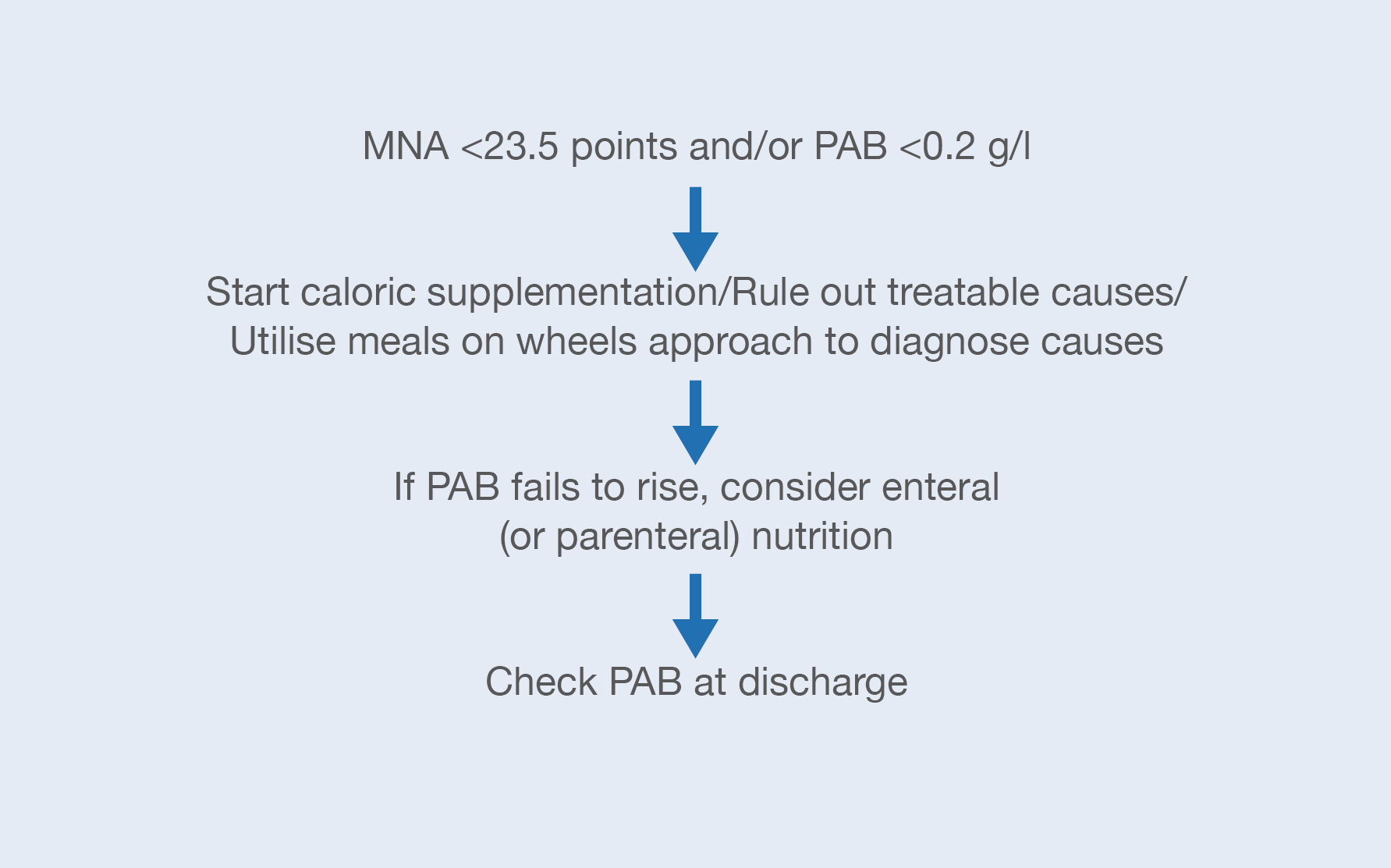
| Method/Intervention:• A prospective observational and interventional 6-month trial. For the first 3 months, the nutritional status of patients was assessed (MNA and serum prealbumin [PAB]) on admission and discharge without particular recommendations for nutritional intervention (observational study – phase 1). • A standardised nutritional intervention was implemented for the last 3 months (intervention study – phase 2). • Nutritional intervention was started when MNA was <23.5 and/or PAB, 0.2 g/l. Treatable causes of malnutrition were identified using the ‘meals on wheels’ approach (see Figure 4.10), and caloric supplementation commenced in line with the algorithm in Figure 4.11. |
||
| Results:• 1,139 consecutive patients were admitted during the study, mean age 82.9 ± 7.3 years, 70% of the patients were women. MNA was measurable in 73% of cases with a median value of 18.5 points (range 9–29), mean admission PAB concentration was 18.5 ± 7.6 mg/100 ml, and C-reactive protein (CRP) was 5.3 ± 7.5 mg/100 ml. • The proportion of patients receiving caloric supplementation significantly increased during the interventional period (20% vs 25% of patients; p <0.01). • Length of hospital stay was significantly shorter during phase 2 than during phase 1 (21.7 ± 15.1 days vs 27.1 ± 21.9 days, p <0.001). |
||
| Conclusions:• Nutritional assessment should be part of routine clinical practice in older hospitalised patients. | ||
| Recommendation:• The experience from this project should be extended to other hospital wards as malnutrition is common in patient groups other than older people. | ||
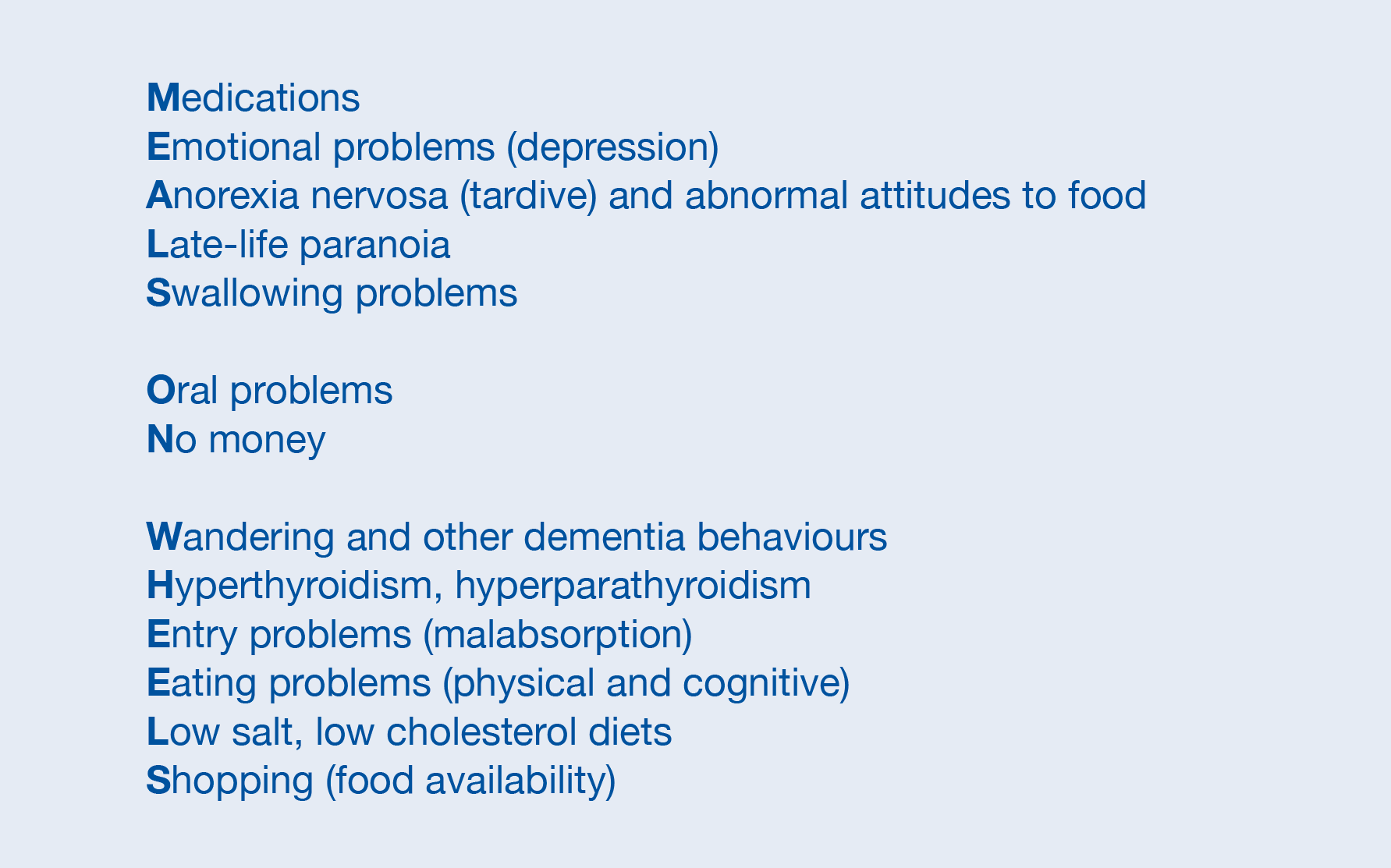
The ‘meals on wheels’ approach to diagnosing treatable causes of malnutrition used in the nutritional care programme in geriatric units in Belgium (adapted from Pepersack 2005)50