
1.3.1 Hospital
 Inadequate food intake is common in adult and older patients in hospital
- Inadequate food intake is common in hospitals despite adequate food provision.226-229
- An analysis of the nutritionDay database from 2006 to 2013 (4519 units, 1358 hospitals and 54 countries, total n =113,930) showed that less than half of all patients finished their meals (41.6%). The most prevalent reasons cited by patients for eating less or nothing were “not being hungry” (30.4%) and “do not like food’s taste” (13.6%).230 In the Australasian Nutrition Care Day Survey undertaken in 2010 (acute care hospitals in Australia and New Zealand, n = 3122), on average 1 in 2malnourished patients (55%) ate ≤ 50% of the food offered and 1 in 3 well-nourished patients (33%) consumed ≤ 50% of the food offered during the survey.49
- A study that included German hospital patients (n=1865) participating in the nutritionDay project from 2016 to 2020 found that low food intake was observed in every fifth patient overall. 231
- In a longitudinal observational study of 100 older (mean age 81.7 years [SD ± 7.2]) inpatients in an inner-city hospital elderly care unit in the UK, patients were judged to be eating inadequately in 67% of assessments (285 out of 425) carried out during the study period of 4 weeks.232
- A cross-sectional observational study in Sweden found eating difficulties to be common in hospital patients (49%). Patients with a low BMI had significantly more eating difficulties than patients with a normal or high BMI.233

 Inadequate food intake is also of concern in children in hospital
- A small Swedish survey of 21 children (median age 14.5 years [range 11–17]) receiving chemotherapy for cancer reported that the causes of poor food intake in children with cancer range from primary changes in taste to the effects of the disease itself, treatment or the environment. The frequency of eating problems is presented in Figure 1.19, with responses shown separately for children, their parents and nurses. Whilst the results show that significant eating problems occur, it is interesting to note that parents generally report these problems more frequently than the children themselves.234
- Access to food may also pose a challenge in meeting the nutritional needs of children in hospital. A survey of current practice in children’s cancer care in the UK found variable facilities for preparation and storage of food and drink for patients. Kitchen facilities were available at 90% of centres; however, there were restrictions in some centres, e.g. no microwave, only a toaster and kettle, no raw food allowed. Two centres had a chef available to cook on demand for children. Most centres (90%) had storage facilities for snacks and over 80% allowed food to be brought in from home.235
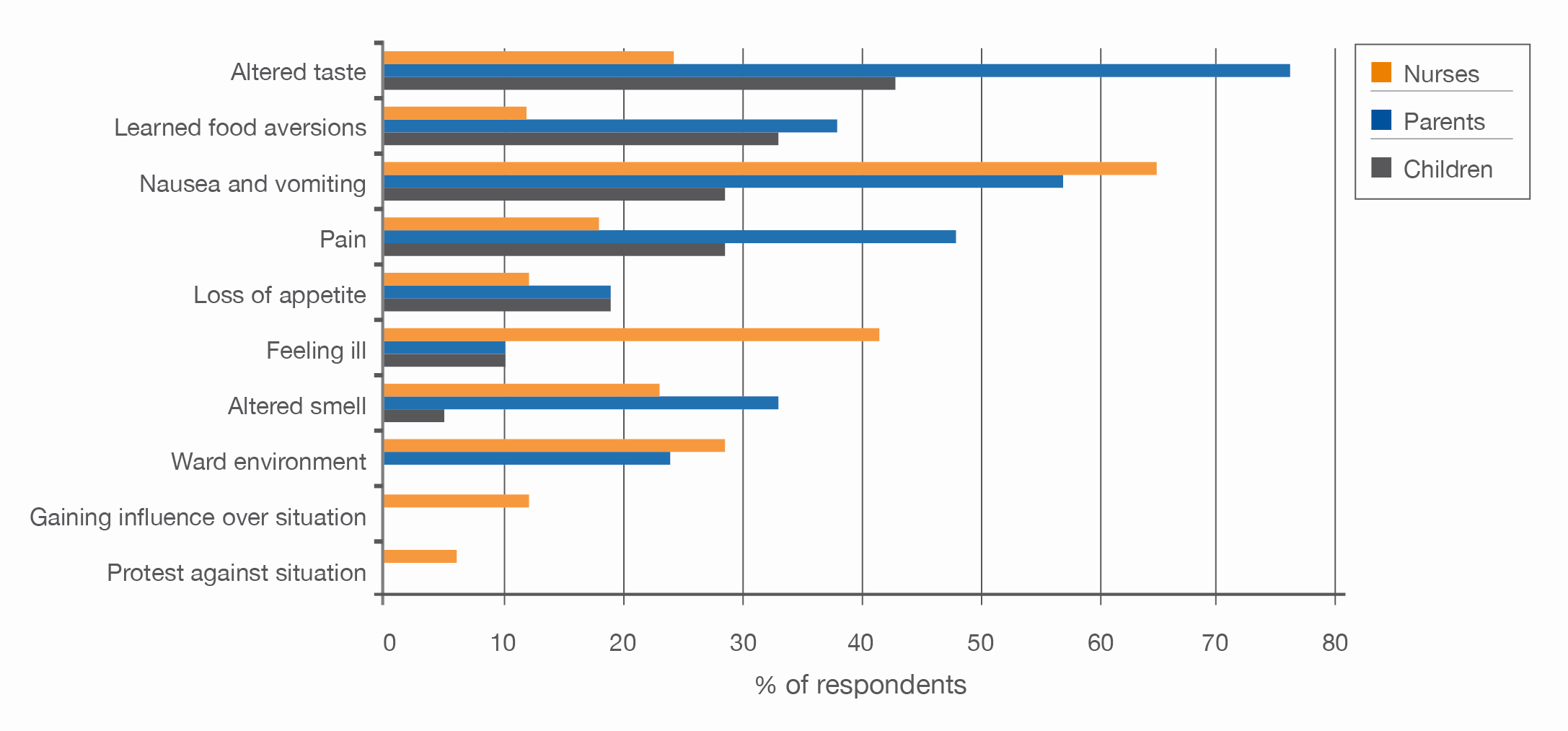
Figure 1.19
Causes and frequency of eating problems among 21 children undergoing chemotherapy for cancer: responses of children, parents and nurses.234
(Note that an individual may contribute to more than 1 category)
Energy intake is compromised and fails to meet recommended intake levels in adult hospital patients
- Stratton et al. (2003) collated studies that measured food intake in a variety of patient groups and demonstrated that in hospital patients, energy intakes fell consistently short of requirements across a spectrum of diseases.53
- In the European nutritionDay Survey (data collected during the 1-day cross-sectional Nutrition Days in 2007 and 2008), data on energy goal and intake was available for 12,398 patients, 47% of whom consumed less energy than their estimated requirements (defined as ≥ 1500 kcal/day for most patients).32
- In a prospective cohort study of older medical hospital patients (n = 134) in a large teaching hospital in Australia, almost two-thirds of patients (59%) did not consume enough dietary intake to meet estimated resting energy requirements, and only 8% of patients had sufficient energy intake for estimated total energy expenditure.236
- A re-audit conducted in a hospital in England to assess whether patients (n = 111) were meeting the recommended energy and protein standards revealed that only 35% of patients met the British Dietetic Association’s Nutrition and Hydration Digest standards for energy, while 63% met the standards for protein. 237
Energy intake may be compromised in children in hospital
- A study of children aged > 6 months admitted to medical or surgical wards for > 48 hours in France (n = 183) found that 67% of malnourished and 70% of non-malnourished patients had an energy intake of less than 75% of the recommended daily allowance.51
- Campanozzi et al. (2009) found that of 496 children aged 1 month to 16 years admitted to medical paediatric wards with mild clinical conditions, 50.4% had a food intake of < 50% of the recommended dietary allowance.52
 Protein intake is compromised in hospital patients, particularly in older people
- Older people and people with compromised health have difficulty meeting recommended intakes for protein, particularly hospitalised older people and orthopaedic patients.53,64,226,238 When compared with typical daily intakes in the healthy population, it is clear that protein intake in a variety of patient groups is severely compromised.53
- Data on dietary intake retrospectively extracted from dietetic records of 610 undernourished adult patients (identified using SNAQ) admitted to a general hospital for > 4 days in The Netherlands in 2008 showed that more than half of the patients (58.4%) did not meet predefined requirements for either protein or energy.239
- A cross-sectional study involving 360 hospital inpatients and nursing home residents aged 75 and older found that energy and protein intake failed to meet required levels in both settings. Among multidisciplinary care patients, 89.5% did not meet energy requirements, and 100% fell short on protein intake. In geriatric care units, these figures were 75.5% and 64.2%, respectively, while in geriatric rehabilitation units, 92.7% had inadequate energy intake, and 90.9% did not meet protein needs. Among nursing home residents, both energy and protein intake were insufficient in 83.8% of cases.240
Micronutrient intake is compromised in adult hospital patients
- Hospital patients, particularly older hospital patients, have lower than recommended intakes of a range of vitamins and minerals. In female orthopaedic inpatients, median intakes of vitamin D, magnesium, potassium and selenium were found to be even below the lower reference nutrient intake.238 Compared with day centre visitors, hospitalised hip fracture patients had significantly lower micronutrient intakes, e.g. 29% lower vitamin B6, 23% lower selenium, 21% lower iron, 20% lower calcium and 20% lower magnesium.64