
4.1.2 Guidelines: From theory to practice for enhanced patient care
Practical guidance for healthcare professionals about when to use ONS is essential and should be a key component of many guidelines
- The method of nutrition support included in these practical guides should be carefully considered and should take account of the evidence base, condition of the patient (both clinical and nutritional), their prognosis, and preferences. Although not based on robust evidence, food fortification is often recommended as the first-line approach with ONS reserved for if/when this strategy is not successful. Care must be taken to review patients on a regular basis and to quickly identify if nutritional goals are not being met so that an alternative strategy can be used, e.g., ONS. NICE (2006) highlights that oral nutrition support strategies are not exclusive and can be used in combination.1
- Practical advice on the use of ONS in clinical practice has been formulated by Stratton and Elia (2007) in a review of reviews on the evidence base for ONS across different patient groups (Figure 4.1).33
- Other examples include an Oral Nutrition Support Algorithm in the UK NICE guideline (Figure 4.2), a table with information about grade of risk of malnutrition, and contribution of spontaneous food intake in the Haute Autorité de Santé recommendations in France (Table 4.12), as well as the five-steps-ladder practical nutritional intervention process by consensus and according to current guidelines which clarified the nutritional strategies for the aged inpatients (Figure 4.3). 74
- In 2012 the National Health Service National Prescribing Centre in the UK published ‘Prescribing of adult Oral Nutritional Supplements (ONS): Guiding principles for improving the systems and processes for ONS use’ (Table 4.13) with the aim of helping organisations ensure that patients can obtain ONS when clinically appropriate and that the systems and processes are in place to:
- monitor on-going requirements for ONS;
- monitor concordance (compliance or adherence) and;
- monitor patients’ clinical condition after a decision is made to discontinue ONS when it appears it is no longer clinically indicated.
- ‘Managing Adult Malnutrition in the Community’, a practical guide based on clinical evidence and best practice, has been developed in the UK by a multi-professional consensus panel. It has been endorsed by 10 key healthcare professional associations and has been designed to support GPs and other community healthcare professionals to identify and manage individuals at risk of disease-related malnutrition. Amongst other relevant topics, it includes:
- information about managing malnutrition according to risk category, including practical tips to aid clinical judgement
- a pathway for using ONS in the management of malnutrition (see Figure 4.4);
- information on optimising oral intake, providing an overview of the practical elements and evidence for dietary advice and ONS
- These practical guides allow healthcare professionals to make decisions about the appropriate use of ONS.
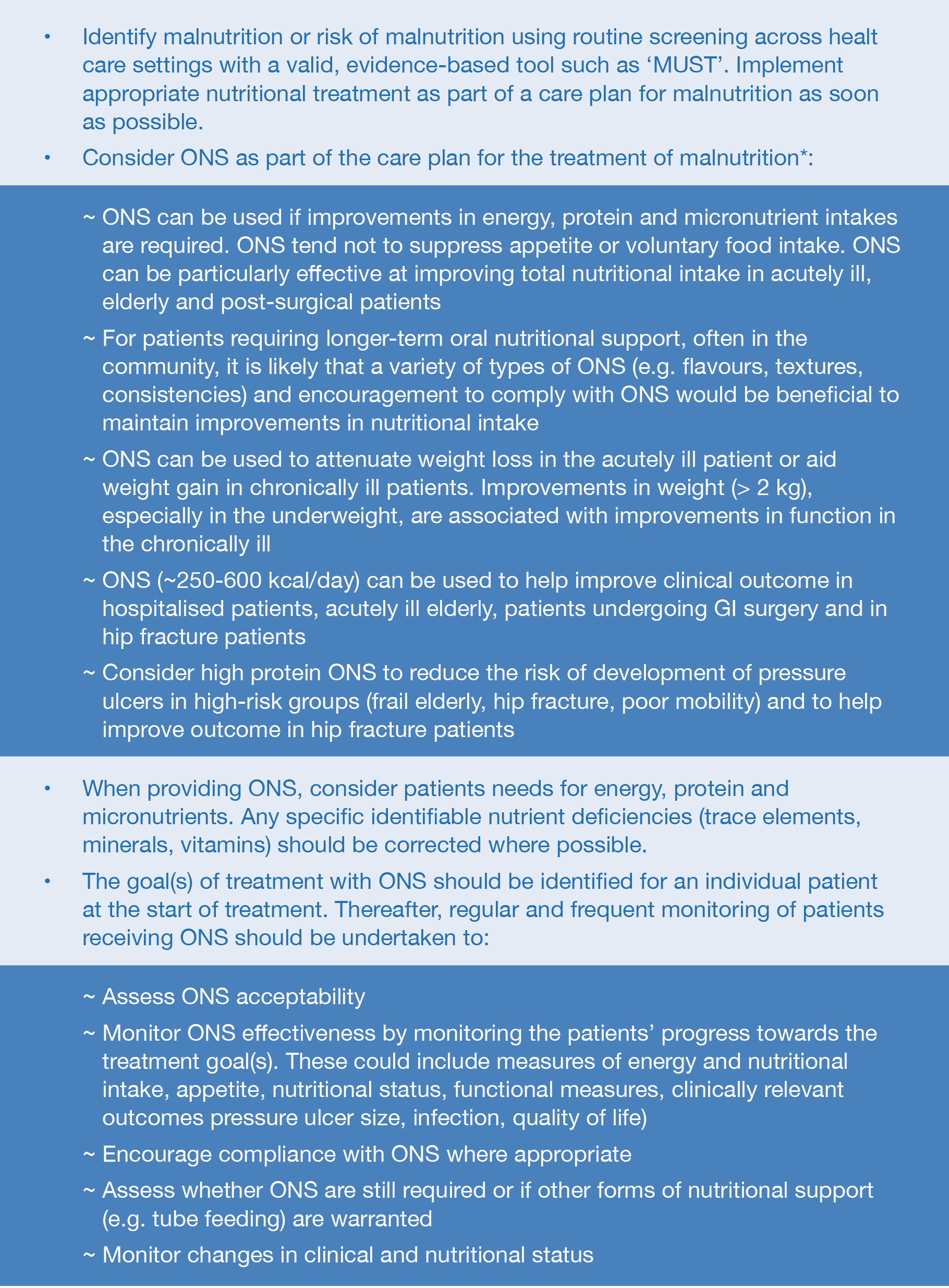
Recommendations for use of ONS in clinical practice (adapted from Stratton and Elia. 2007) 75
*The care plan, including when to refer to a dietitian or nutrition support team, should be devised by a multidisciplinary team according to local policy and resources
Example of a nutritional management strategy detailing when to use ONS for older people (adapted from Haute Autorité de Santé 2011)18
| Nutritional Status | ||||
|---|---|---|---|---|
| Spontaneous dietary intake | Normal | Malnutrition | Severe Malnutrition | |
| Normal | Monitoring | Dietary advice Fortified diet Reassessed* at 1 month |
Dietary advice Fortified diet & ONS Reassessed* at 15 days |
|
| Reduced, but more than half of usual intake | Dietary advice Fortified diet Reassessed* at 1 month |
Dietary advice Fortified diet Reassessed* at 15 days and if failure: ONS |
Dietary advice Fortified diet and ONS Reassessed* at 1 week, if failure: Enteral Nutrition |
|
| Very reduced and less than 50% of normal intake | Dietary advice Fortified diet Reassessed* at 1 week, and if failure: ONS |
Dietary advice Fortified diet and ONS Reassessed* at 1 week, and if failure: Enteral Nutrition |
Dietary advice Fortified diet and Enteral Nutrition from outset Reassessed* at 1 week |
|
*Reassessment should include: Weight and nutritional status, clinical condition and prognosis, estimation of spontaneous food intake, tolerance, and compliance with treatment
Recommendations for use of ONS in clinical practice for Geriatrics – ESPEN Practical Guidelines (adapted from Volkert et al, 2022) 26
- Older persons with malnutrition or at risk of malnutrition and chronic conditions should be offered ONS when dietary counselling and food fortification are insufficient to meet nutritional needs (R23, Grade GPP, strong consensus 100%).
- Hospitalised older patients with malnutrition or at risk of malnutrition should be given ONS to improve dietary intake and body weight (BW) and reduce the risk of complications and readmissions (R24, Grade A, strong consensus 100%).
- After discharge from the hospital, older persons with malnutrition or at risk of malnutrition shall be offered ONS in order to improve dietary intake and BW and to lower the risk of functional decline (R25, Grade A, strong consensus 100%). ONS should provide at least 400 kcal/day, with 30g or more of protein/day for older adults with malnutrition or at risk of malnutrition (R26, Grade A, strong consensus 97%).
- When offered to an older person with malnutrition or at risk of malnutrition, ONS shall be continued for at least one month. Efficacy and expected benefit of ONS shall be assessed once a month. (R27, Grade GPP, strong consensus 100%).
- When offered to an older person with malnutrition or at risk of malnutrition, compliance in ONS consumption shall be regularly assessed. Type, flavour, texture and time of consumption shall be adapted to the patient’s taste and eating capacities. (R28, Grade GPP, strong consensus 100%).
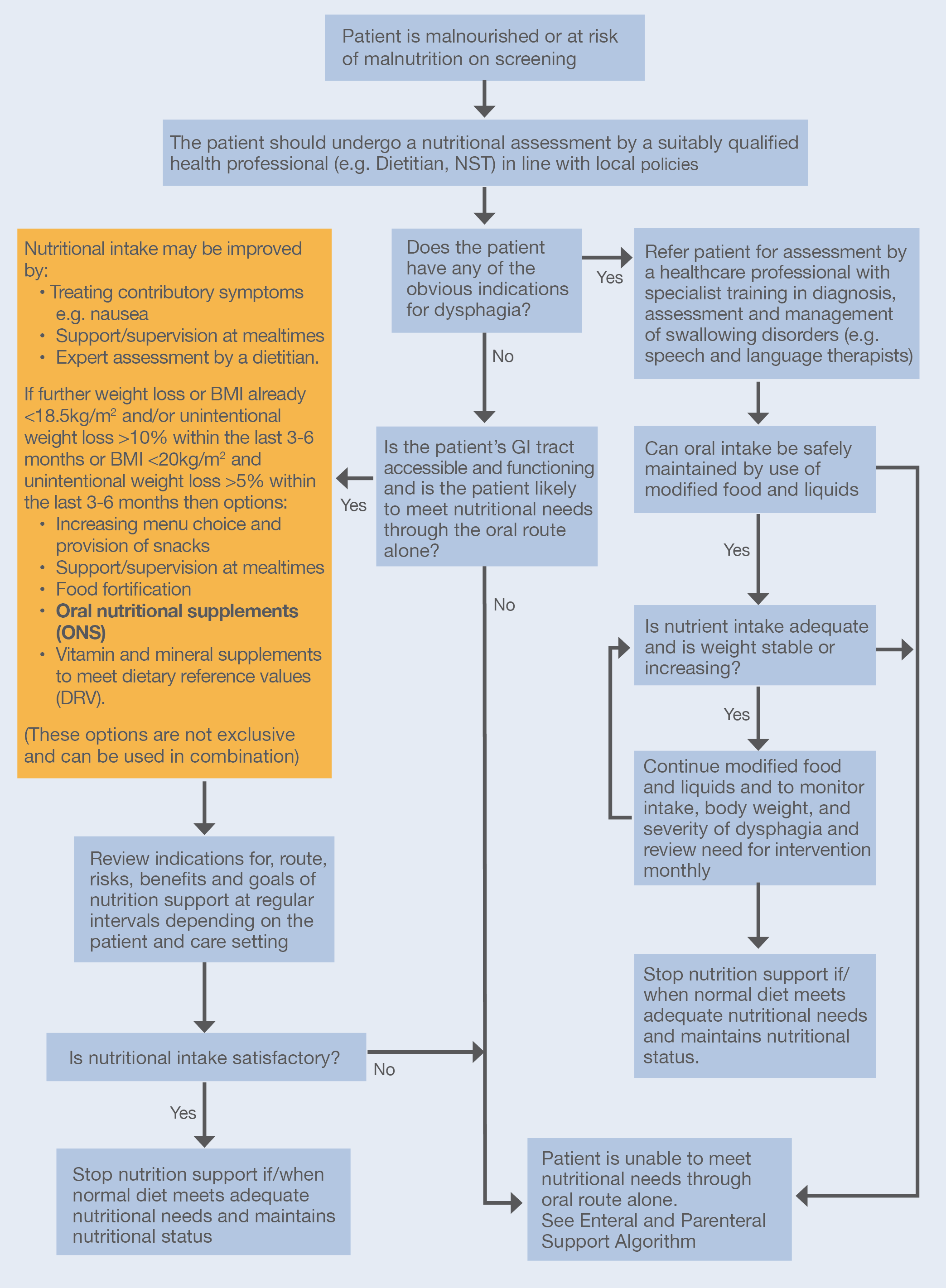
Oral Nutrition Support Algorithm (adapted from NICE, 2006) 3
Ten Guiding Principles for improving the systems and processes for ONS use (adapted from NHS National Prescribing Centre [NPC]: Prescribing of adult ONS, 2012)*
| 1 | Local health economies should understand their local clinical need for adult oral nutrition support and map this against local workforce expertise. |
|---|---|
| 2 | Local health economies should understand their local procurement arrangements for adult ONS in primary, secondary, and social care. |
| 3 | Commissioners should review prescribing arrangements for adult ONS. |
| 4 | Local health economies should ensure that a validated screening tool such as the ‘Malnutrition Universal Screening Tool’ (‘MUST’) is embedded into everyday care so that the results of screening are linked to a care plan. |
| 5 | Local health economies should develop standard templates for care plans to be used with ‘at-risk’ adult patients across primary, secondary, and social care. Goals should be set, and the care plan monitored and reviewed so that oral nutritional supplements are used appropriately. |
| 6 | Local health economies should work with care home commissioners and providers to ensure high standards of nutritional screening, education, and assessment for oral nutritional support are embedded in the care home environment. |
| 7 | Local health economies should assess local training needs for all health and social care staff for the identification and treatment of adult undernutrition and implement an education programme for all appropriate front-line staff, carers and patients. Competencies for basic skills should be developed. |
| 8 | Local health economies should develop measurements for assessing the quality of the provision of adult ONS. |
| 9 | Commissioners should consider incentives to improve adult oral nutrition support and prescribing practice. |
*In April 2011 the NPC integrated into the National Institute for Health and Clinical Excellence (NICE). However, the guiding principles do not constitute formal guidance of the National Institute for Health and Clinical Excellence. More information available at https://www.webarchive.org.uk/wayback/archive/20130426203534/http://www.npc.nhs.uk/quality/ONS/resources/borderline_substances_final.pdf
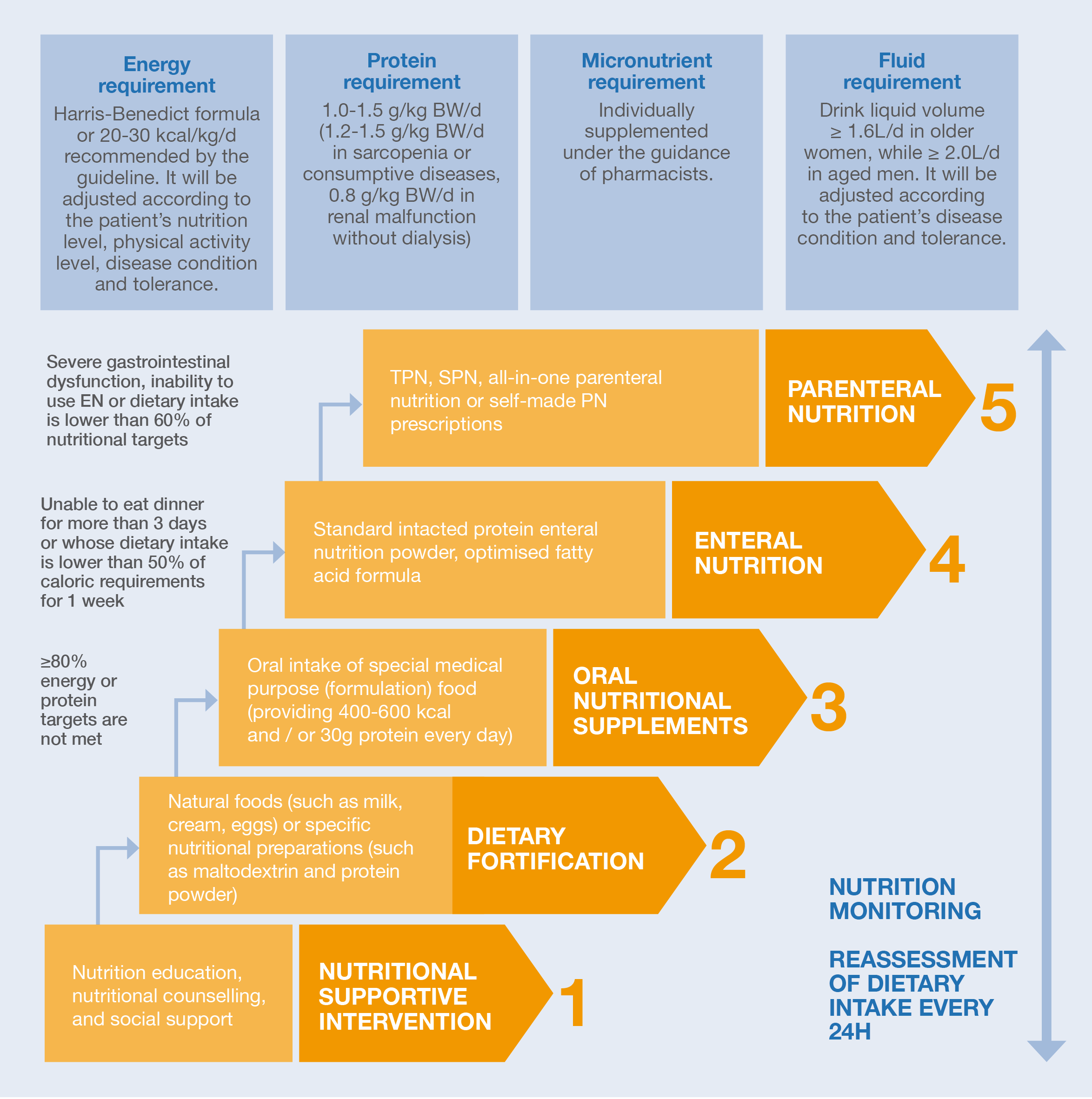
Five-Steps-ladder Nutritional Approach (adapted from Ji et al. 2022) 74
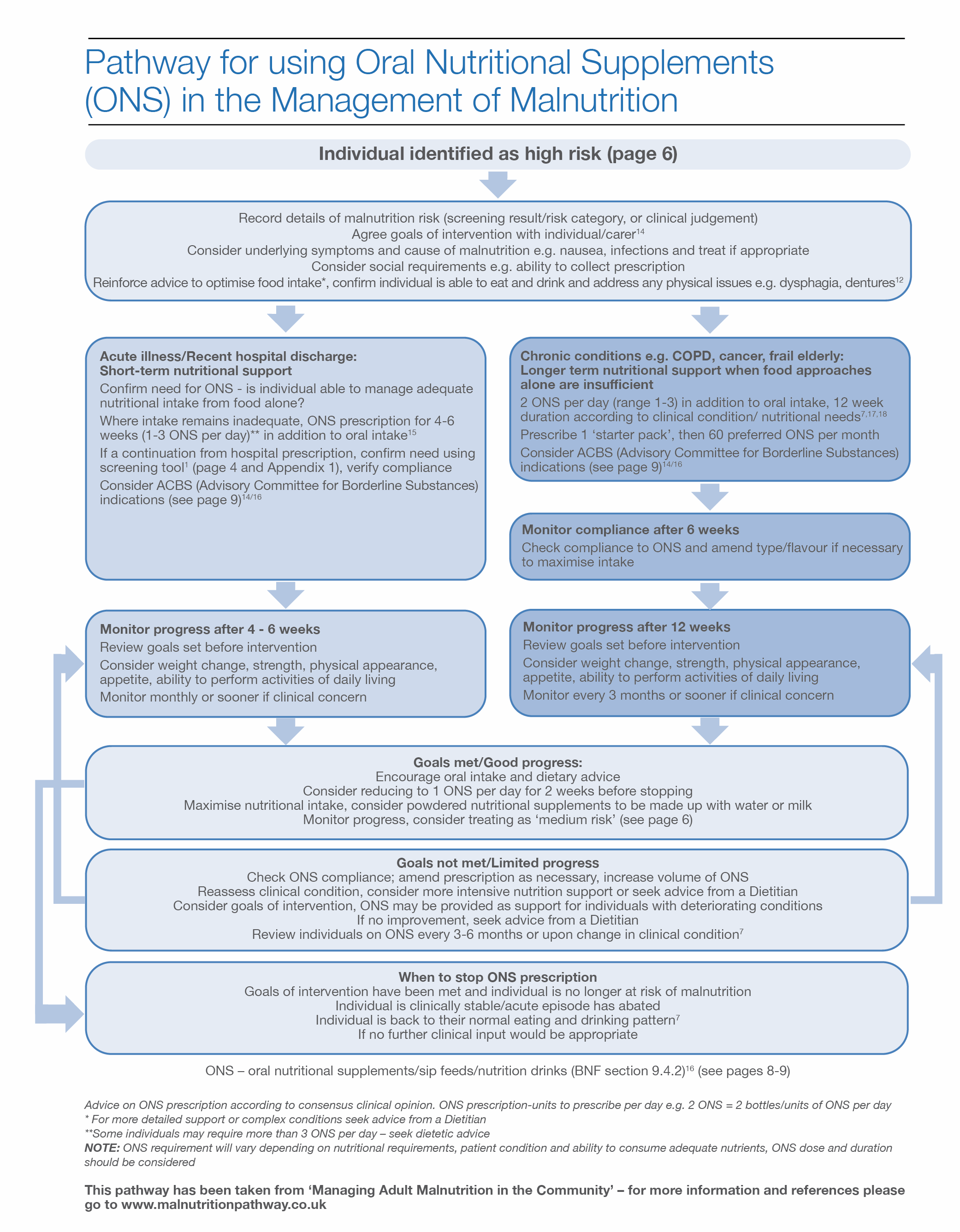
Pathway for using Oral Nutritional Supplements (ONS) in the Management of Malnutrition
Reproduced with kind permission from Anne Holdoway, Panel Chair. For details of references cited within this table and further information please refer to the original document available at http://malnutritionpathway.co.uk/