3. Benefits of medical nutrition
3.1 Benefits of Oral Nutritional Supplements (ONS)
Summary and recommendations
ONS have proven nutritional, functional, clinical, and economic benefits in both the hospital and community setting in a wide variety of patient groups. Studies show that ONS increase energy and protein intakes in both hospital and community patients without reducing spontaneous intake from food; indeed, ONS may help to stimulate appetite, e.g., in post-surgical patients and in older people.
Improvements in clinical outcome and healthcare resource use have been consistently demonstrated in a number of trials and meta-analyses:
- Meta-analyses show that ONS lead to weight gain in patients in hospital and in those transferred to the community, including older people, e.g., average weight change between supplemented and control group +3%. A more recent meta-analysis showed that ONS enhanced weight and caused an average weight gain of +0.423 kg.
- Meta-analyses consistently show that patients receiving ONS have reduced mortality compared to those receiving standard care, such as nutritional counselling. (e.g., 24% reduction), particularly in undernourished older people.
- Reductions in complication rates of between 25% and over 50% are seen in meta-analyses of ONS compared with routine care (no nutritional counselling or ONS, nutritional counselling without ONS). Meta-analysis shows that use of ONS significantly reduces the proportion of patients (affected by a variety of conditions) admitted or readmitted to hospital compared with routine care (24% vs 33%).
- High-protein ONS (compared to control groups that were provided a placebo, nutritional counselling, or a standard diet) have been shown to reduce readmissions by 30%.
- Post-discharge nutritional support improves survival and nutritional intake.
Improvement in quality of life, activities of daily living, muscle strength, respiratory muscle function, and sleep scores have been demonstrated in patients receiving ONS. ONS have been demonstrated to be more effective than dietary advice and snacks; greater intakes of energy, protein, and vitamins and fewer complications have been shown in patients with fractured neck of femur when compared with snacks (with equal energy content). Significantly greater energy and protein intakes with ONS have been reported in a randomised controlled trial of ONS versus dietary advice in care home residents.
Potential cost savings as a result of reduced healthcare use have been demonstrated in patients supplemented with ONS and can be realised in both the hospital and the community setting. Economic modelling undertaken by NICE (in 2006 and 2012) showed ONS to be cost-effective as part of a screening programme.
Comprehensive systematic reviews have shown that managing malnutrition with ONS can produce an average cost saving of around 10% compared to standard care (such as nutritional counselling without ONS) across a broad range of patient groups. Meta-analyses in hospitalised patients show that ONS use is associated with 1 in 3 fewer deaths, 1 in 3 fewer complications and shorter length of hospital stays.
In a Swiss study, individualised nutritional support (including ONS) reduced 30-day hospital costs by €199 (CHF 214) per patient (0.73%), mainly by reducing ICU stays and complications. U.S. nursing homes using wound-specific ONS saw an annual cost reduction. Global studies and analyses have shown that in-hospital nutritional support and ONS in various forms lead to cost reductions, fewer infections, and improved survival outcomes. Specifically, a study conducted in France found that ONS in cookie form reduced falls and infections, with daily savings of €1.52–€2.48 per resident and a 30-minute reduction in staff workload. Cost-effectiveness studies, such as the US NOURISH study, highlight ONS’s potential to improve quality of life and survival at a lifetime ICER of $524/LY. These findings demonstrate ONS’s role in enhancing patient outcomes and reducing healthcare costs, which will be explored in further detail.
A holistic approach must be taken when considering the investment needed to manage malnutrition; the cost may be incurred in one setting, whilst the benefit appears to occur in another. However, taken as a whole, effective prevention and management of malnutrition will realise cost savings across the social and healthcare system.
Conclusion
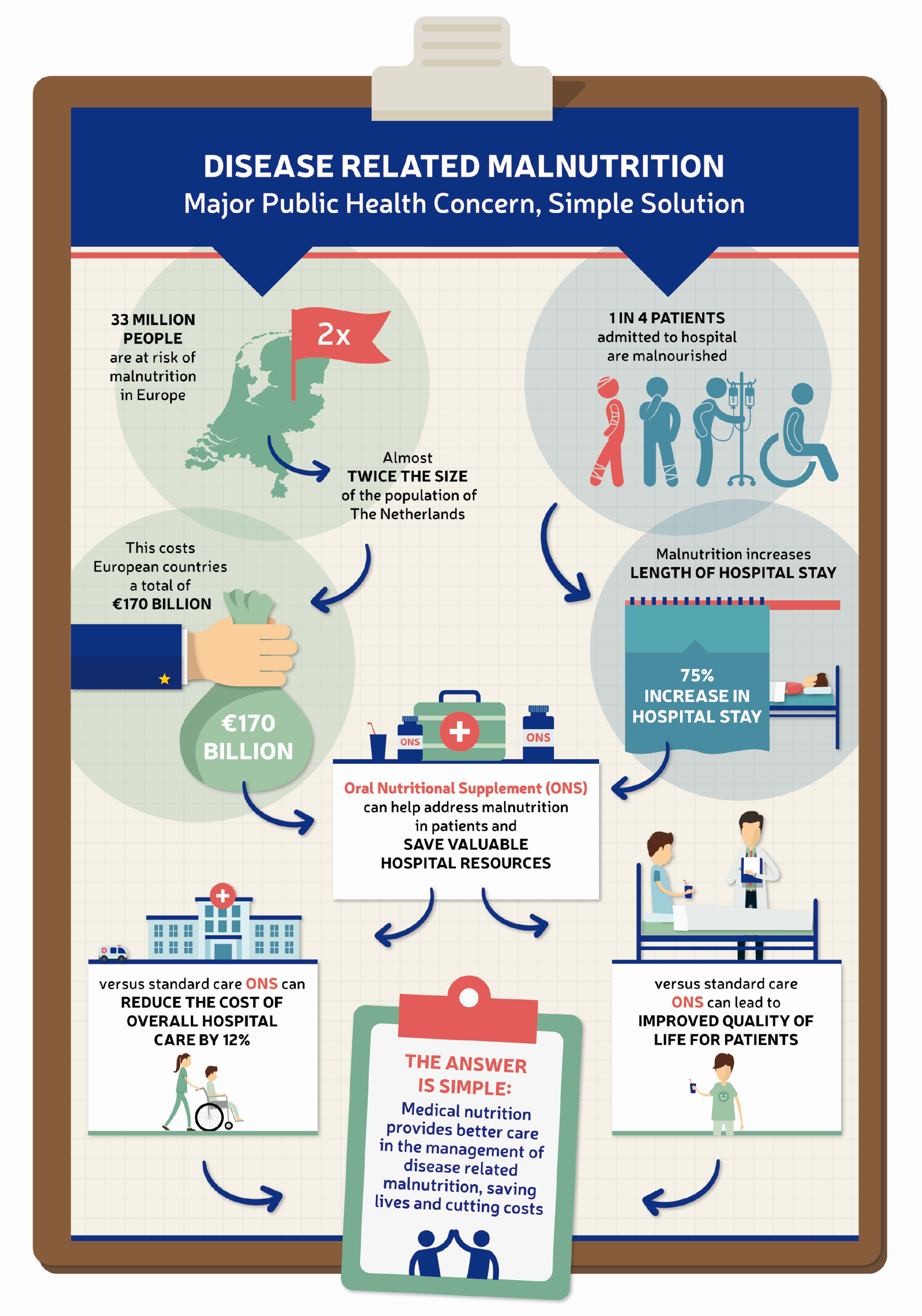
There is consistent, good quality evidence from multiple individual trials and meta-analyses demonstrating the beneficial nutritional, functional and clinical effects of ONS in malnourished patients. Besides improving the well-being of patients, fighting malnutrition with ONS is an opportunity for healthcare providers to control costs. This is especially relevant in light of the ageing population and the high prevalence of chronic disease that adversely impacts nutritional status, which in turn contributes to increased cost burden. Nutritional support with ONS after discharge has been demonstrated to increase nutritional intake and survival, but its impact on lowering readmissions is yet unknown. Moreover, ONS has been shown to enhance energy intake and nutritional status in dementia patients, improving overall health outcomes, however effects on cognitive function remain inconsistent. Lastly, economic evaluations have shown that individualized nutritional support with ONS can lead to shorter hospital stays, fewer ICU admissions, and significant cost savings. Controlling and managing malnutrition is a clinically and cost-effective solution. This approach is summarised in the infographic presented in Figure 3.1.
Recommendations
On the benefits of ONS the MNI makes the following recommendation:
| Action | Issues to consider |
|---|---|
| A wealth of evidence is available that demonstrates the benefits of ONS. This should be translated into practice to ensure that patients who need nutritional intervention receive it in a timely and appropriate manner |
|