
3.1.2 Functional benefits of ONS
 ONS lead to functional benefits in adult hospital patients
In a review by Stratton et al. (2003), a number of individual RCTs in hospital patients showed significant improvements in functional measures with ONS compared with a control group, such as:2
- improved ventilatory capacity in patients with COPD;
- improved functional benefits, including increased activity (assessed using Norton scores) and activities of daily living (ADL) levels in older people;
- retention of skeletal (hand-grip) muscle strength and improved physical and mental health/QOL in surgical patients.
- In post-stroke patients admitted to a stroke service in a rehabilitation hospital and allocated to receive intensive ONS (higher energy, protein and vitamin C content) compared with standard ONS, significant improvements in functional and mobility measures were observed in the intensive ONS group (Functional Independence Measure [FIM] total score [31.49 intensive vs 22.94 standard, p < 0.001], FIM motor sub-score [24.25 vs 16.71, p < 0.001], 2-minute walk [101.60 vs 43.98, p < 0.001], and 6-minute walk [299.28 vs 170.59, p < 0.001]).54
- ESPEN guidelines emphasise the importance of ONS in polymorbid hospital patients to prevent functional decline. In this population, nutritional interventions are associated with improved muscle strength, better rehabilitation outcomes, and reduced frailty. The recommendations suggest integrating ONS into hospital protocols to enhance mobility and physical function, particularly in patients at risk of malnutrition. Functional recovery and reduced hospital dependency are key outcomes of targeted nutritional strategies.12
 ONS lead to functional benefits in adult patients in the community
The comprehensive review undertaken by Stratton et al. (2003) showed that in individual randomised controlled studies, ONS led to significant improvements in functional parameters compared with controls in patients in the community, such as:2
- improved respiratory muscle function, hand-grip strength, and walking distances in patients with COPD;
- increased ADL levels and reduced number of falls in older people.
- A systematic review carried out by Cawood et al. (2023) evaluated the impact of ONS in community settings and found 30% reduction in complications including infections, pressure ulcers, wound and fracture healing with ONS use.55
- ONS use was associated with increased energy and protein intake.56
- ONS was associated with better body composition and nutritional status.57
- A systematic review of trials investigating omega-3 PUFA-enriched ONS in cancer patients undergoing chemotherapy or radiotherapy found significant functional benefits. Patients who received ONS maintained better muscle strength, reported reduced fatigue, and exhibited improved physical performance compared to controls. The study suggests that omega-3-enriched ONS can support functional outcomes by mitigating treatment-related muscle loss and enhancing recovery.58
- A systematic review assessing nutritional interventions—including ONS, dietary counselling, and resistance exercise—in heart failure patients at risk of malnutrition found improvements in functional capacity and physical performance. Benefits such as increased exercise tolerance, better grip strength, and improved quality of life were observed in both hospitalised and community-dwelling patients. These findings suggest that comprehensive nutritional strategies, including ONS, can help maintain functional independence and mitigate disease-related decline in this population.59
 ONS lead to significant functional benefits, particularly in older people in the community
- Significant functional improvements have been reported in patients receiving ONS in a number of trials, particularly in older people in the community (see Table A2.1, Appendix 2).
- In studies where older patients were given high-protein ONS, improvements in hand-grip strength, objective measures of physical activity, depressive symptoms and QOL, particularly in physical scales, have been reported compared with controls.39,60,61
- Supplementation with ONS for between 6 and 16 weeks has shown positive effects on functional outcomes (patients receiving supplements for 6 weeks commenced ONS in hospital and continued after discharge).60,61
- Improvement in Katz ADL levels was observed in older patients at risk of malnutrition randomised to receive ONS and dietary counselling on discharge from hospital for 4 months in treated-as-protocol analysis (p < 0.001; p < 0.05 between groups) (see Figure 3.14).38
- Milne et al. (2009) reported that meta-analysis of measures of functional status was not possible as the measures reported in trials were often disease-specific and too diverse to integrate for analysis.18 Some studies were not included in the review by Milne et al. (2009) as they appear to have been published after the point at which searches were completed, e.g., Norman et al. (2008) and Gariballa et al. (2007) (functional outcomes of these studies are therefore summarised above or in Table A2.1, Appendex 2).31,60,61
- A systematic review and meta-analysis of 12 studies assessing the effect of ONS in older adults with dementia showed a significant improvement in cognition (measured by mini mental state examination, (p = 0.002)) at 6.5 ± 3.9 month follow-up when ONS were given compared to the control group (usual care in 8 studies, placebo drink/supplement in 4 studies).21 There was no statistically significant difference between the control groups and the intervention (ONS) groups for functional ability (ADL) in the 3 studies that measured this outcome for 326; 43 or 6 months.62 It is possible that follow up of a much larger group for a longer period of time would be necessary to see any significant reductions in the deterioration rates for performance of ADL especially as subjects only received ONS for 3 months in 2 studies and 5 months in another and only followed up for up to 6 months.21
- A systematic review of nine clinical trials assessing the effects of ONS in older adults with dementia (total N = 407, aged ≥60 years) showed significant improvements in nutritional intake and status. ONS increased energy (201–600 kcal/day) and protein intake (9–42 g/day) across intervention groups without suppressing voluntary food consumption. Body weight, muscle mass, fat-free mass, and nutritional biomarkers (e.g., albumin, vitamin B12) improved significantly with ONS use. However, no consistent effects on cognitive function or activities of daily living (ADL) were observed.25
- Edington et al. (2004) reported a significant improvement in hand-grip strength during supplementation of older malnourished patients in the community, but this was not sustained after supplementation was stopped. Furthermore, positive effects on QOL were not seen, although mobility scores were better in the ONS group than in the controls. The authors concluded that in a group of already malnourished subjects, who have many serious underlying disorders, it may be too late to expect to see improvements in functional or QOL parameters simply by providing a short course (8 weeks) of ONS, and that supplementation for a longer period may possibly have a more profound effect.63
- A prospective multicentre observational study examined 191 malnourished community-dwelling adults aged ≥70 years to evaluate the effects of ONS prescriptions on healthcare costs, hospitalisation risk, and patient-reported outcomes. Patients prescribed ONS (70%) were more disabled and had poorer baseline health perception, appetite, and quality of life compared to those not receiving ONS. After 6 months, appetite improved significantly in the ONS group, though weight change did not differ between groups. While ONS recipients had a higher crude rate of hospitalisation, adjusted analyses showed no overall increase in healthcare costs. Importantly, patients with higher ONS intake (≥500 kcal/day or ≥30 g protein/day) had significantly lower hospitalisation rates and reduced costs, indicating a dose-dependent benefit of adequate ONS consumption.64
- A randomised controlled trial found that participants receiving ONS with dietary counselling demonstrated had significantly greater leg and handgrip strength and improved functional outcomes than those receiving a placebo supplement. The study supports the role of ONS in maintaining functional independence and slowing the progression of frailty in older adults.8
- A systematic review and meta-analysis of 44 randomised controlled trials assessing the effects of oral nutritional supplements (ONS) in community and mixed settings (hospital and community) showed that ONS significantly reduced complications such as infections, pressure ulcers, and wound healing issues (OR 0.68, 95% CI 0.59–0.79; p < 0.001). This included benefits in both purely community-based interventions (OR 0.65, 95% CI 0.52–0.80; p < 0.001) and those bridging hospital and community settings (OR 0.72, 95% CI 0.59–0.87; p = 0.001). Complication rates were lower in the ONS group (28%) compared to the control group (40%), translating to a 30% reduction in incidence.55
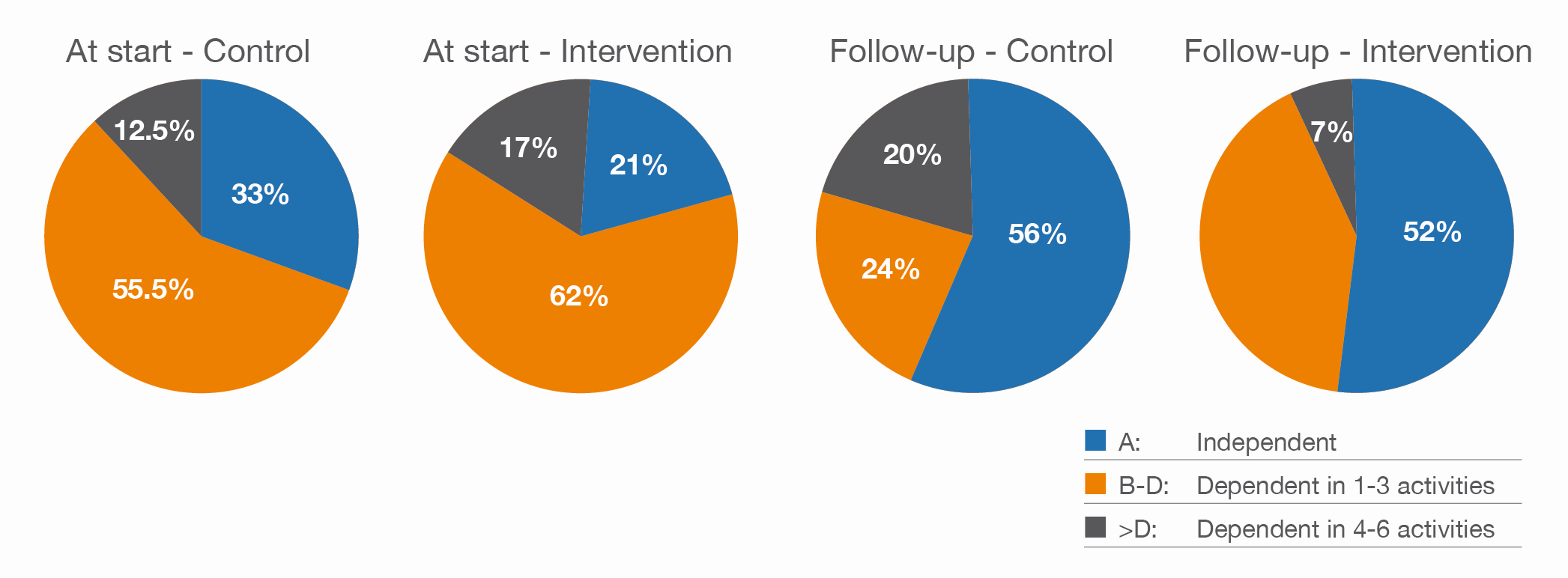
Figure 3.14
Activities of daily life (ADL) registered by the Katz Index at the start and after 4 months of intervention (adapted from Persson et al. 2007) 38
Activities included: bathing, dressing, toilet, transfer, continence and feeding
- Malnourished older people with a variety of conditions randomised to receive ONS post hospital discharge had a significant decrease in functional limitations (mean difference -0.72, 95% CI -1.15 to -0.28) with no difference in costs compared with patients who received usual care.65
Emerging data demonstrates that ONS can improve QOL in care home residents
- QOL (adjusted for baseline QOL, malnutrition risk, type of care received [nursing or residential]) was found to be significantly higher in care home patients managed with ONS rather than dietary advice (intention to treat analysis at week 12 weeks; n = 104). EQ-5D TTO scores (mean ± SE) were 0.50 ± 0.04 vs 0.36 ± 0.05 (p < 0.005), representing a 39% improvement in HRQOL (UK).28
- ONS prescribing guidelines66 recognize that nutrition support may focus on quality of life and symptom relief in institutionalised older adults. While the guidelines do not elaborate on specific improvements, ONS may contribute to preventing malnutrition-related functional decline, with potential benefits for physical function, and overall quality of life.67
- Intervention with low-volume, energy and nutrient-dense ONS in malnourished or at risk of malnutrition nursing home residents (n = 77; 87±6 years, 91% female) increased positive self-perception (1 of 10 QOL categories) (Germany).68
- In the same systematic review and meta-analysis, four studies from various settings—including community and hospital-based contexts—investigated the impact of ONS on QoL. Two studies reported on overall QoL scores, while the other two focused on psychological and physical subdomains. The findings were inconsistent, with mixed results on overall QoL and physical function. However, one of the two studies assessing psychological aspects reported a positive effect of ONS compared to standard care.69
High-protein ONS can improve hand-grip strength in older community patients
- A systematic review and meta-analysis of 4 RCTs in community patients with COPD, GI disease and hip fracture found that multi-nutrient, high-protein ONS can significantly improve hand-grip strength compared with the controls (1.76kg [95% CI 0.36–3.17], n = 219, p = 0.014 random effects model).9
ONS in combination with exercise training can improve muscle strength in older people
- Improvements in muscle strength and muscle power have been observed among frail older people in the community and in long-term care settings who received resistance training/ physical exercise in conjunction with ONS.70,71
- ONS supplementation has been shown to improve muscle strength, including hand grip strength, in various patient populations. A randomised controlled trial in community-dwelling older adults at risk of malnutrition found that ONS intake significantly enhanced hand grip strength, gait speed and daily functional and physical abilities.72
- Similarly, a systematic review on heart failure patients identified that those receiving ONS demonstrated increased exercise tolerance and improved grip strength, supporting its role in maintaining muscle function and physical independence.59