
3.2.5 Economic benefits of ETF
Elia et al. 2015 summarised some of the issues regarding the evaluation of the economic benefit of ETF:7
‘It can be argued that use of ETF/PN in certain groups of hospitalised patients can produce at least some favourable budgetary consequences by aiding recovery from illness and reducing the length of hospital stay. It can also be argued that a cost impact analysis is of limited value when applied to treatments such as home ETF/PN, which are often used to save lives rather than save money. It may be more appropriate to assess the value of home ETF/PN using a cost-effectiveness analysis, based on societal thresholds for willingness to pay, rather than using a budget impact analysis.’
 ETF in the hospital setting may lead to cost savings
- A systematic review of ETF in the hospital setting by Stratton et al. concluded that small reductions in hospital stay may accompany ETF and that cost savings are likely to occur when complication rates are markedly reduced.50
- Findings show that ETF offers clear economic advantages, by decreasing healthcare system burden and avoiding costs associated with longer inpatient care or complications from malnutrition.57
- The report from the Malnutrition Action Group of BAPEN and the National Institute for Health Research Southampton Biomedical Research Centre estimated the potential savings from reduced length of hospital stay associated with use of ETF and PN to be approximately €12.4 millionⁱⁱⁱ (£11 million) in England (see Table 3.10).7
Potential annual cost saving from reduced healthcare utilization (adapted from Elia et al. 2015)2
| Cost saving | Amount |
|---|---|
| Reduced length of hospital stay (oral, mainly ONS) | £89,682,364 |
| Reduced length of hospital stay (ETF + PN)* | £11,122,060 |
| Reduced healthcare use (from extra OP activity)** | £11,355,100 |
| Reduced hospital admissions | £9,717,306 |
| Reduced GP visits | £3,866,242 |
| Reduced OP visits | £906,915 |
| Total potential cost saving | £126,649,987 |
| (£115,527,927)† | |
| (£101,806,313)‡ | |
| (£112,928,474)+ |
The values shown do not reflect the net balance. They represent the cost savings, from which the costs need to be subtracted to establish the overall net balance or budget impact. The blue shaded areas represent cost savings only when it assumed that the financial benefits are equal to additional costs so that the final budget impact or net cost saving remains cost neutral. Without a cost saving from these sources the potential budget impact is £104,172,827
* Assumed to be equal to the cost of the extra ETF and PN in hospital
** Assumed to be equal to the cost of the extra outpatient (OP) activity, the benefit of which could occur in multiple settings, part of a sensitivity analysis). Other models assumed no cost saving from ETF and PN
† All forms of oral nutrition support only
‡ ONS only
+ Without oral (non-ONS), i.e. ONS, ETF, and PN onlyⁱⁱⁱCalculated based on an exchange rate of 1 GBP = 1.1245 EUR (Source: Interbank 12/07/2017)
- The same report indicates that the use of nutritional support including ONS, EFT and PN ultimately saves rather than costs money €134,000 – €486,000ⁱᵛ (£119,000 – £432,000 per 100,000 depending on the model used) (see Figure 3.54). It is necessary to make a commitment to invest money before the financial benefits can be reaped.
ⁱᵛCalculated based on an exchange rate of 1 GBP = 1.1245 EUR (Source: Interbank 12/07/2017). ᵛCalculated based on an exchange rate of 1 USD = 0.8712 EUR (Source: Interbank 12/07/2017)
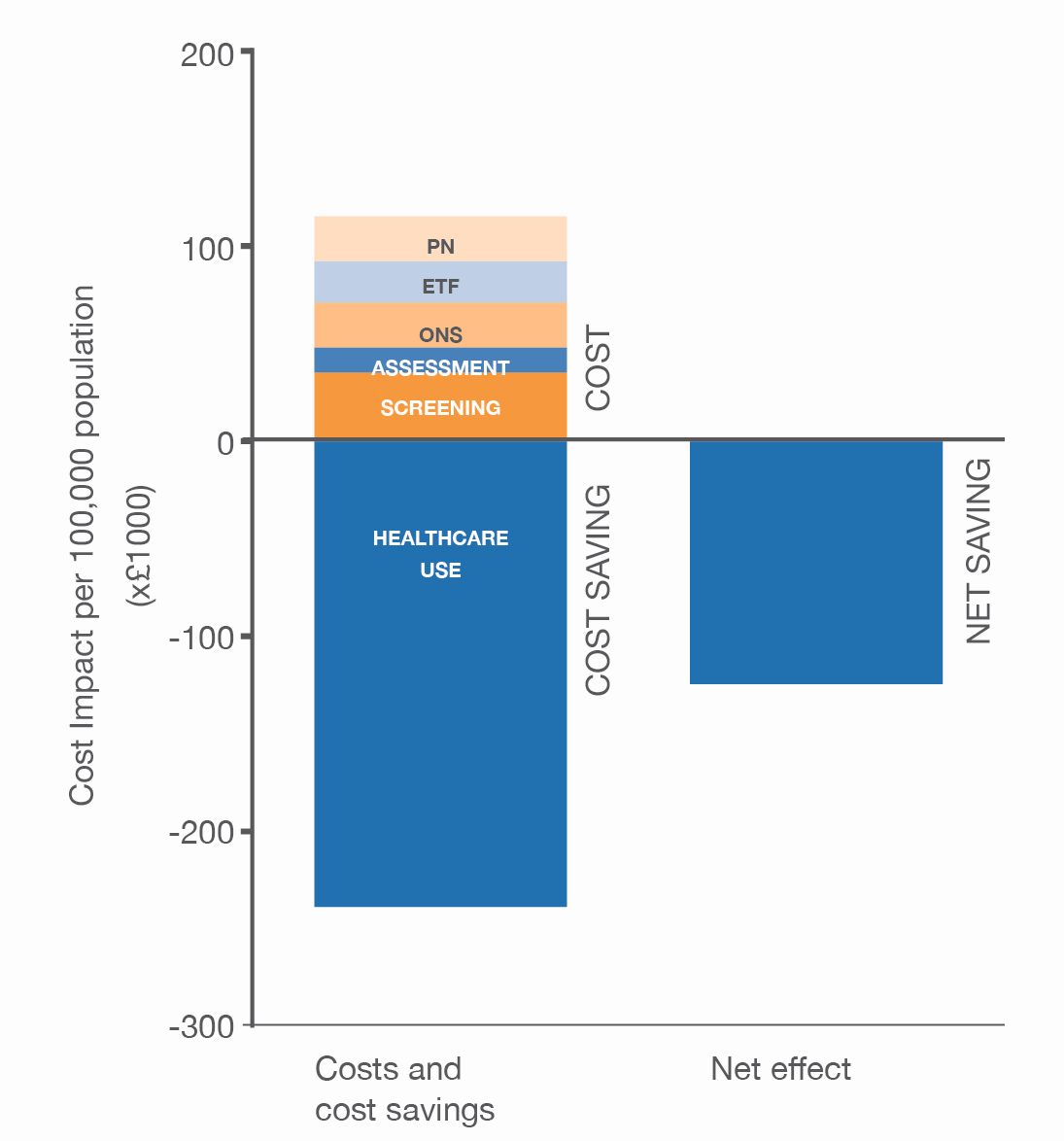
The costs, cost savings and budget impact (net effect) of providing nutritional support to 85% of subjects with high risk of malnutrition. (Adapted from Elia et al. 2015)7
PN = parenteral nutrition, ETF = enteral tube feeding, ONS = oral nutritional supplements.
 ETF in the community can be cost-effective in adults and children
- A systematic review of ETF in the community by Stratton et al. concluded that the increasing use of ETF at home provides substantial cost saving to the hospital but places greater demands on carers in the community, who are often family members.50
- A multi-centre observational study was undertaken in 4 Polish medical centres after the introduction of reimbursement for commercial ETF (n = 456, 142 children and 314 adults). Before this point all patients who required HETF used ‘homemade blenderised kitchen diets’ administered via their feeding tube. Data was collected retrospectively for a 12-month period on homemade feeds and prospectively for a 12-month period on commercial feeds. In terms of healthcare resource use there were significant reductions in:30
- Number of hospital admissions (1.98 ± 2.42 vs 1.26 ± 2.18, p <0.001);
- Length of hospital stay (39.7 ± 71.9 days vs 11.9 ± 28.5 days, p <0.001).
Use of ETF for over one year decreased the average length of stay by 27 days (39.7 vs 11.9 days, p <0.001). Mean (± SD) annual costs for hospitalisation were reduced from €5663 ± 9063 to €1806 ± 4789ᵛ ($6500 ± 10403 to $2073 ± 5497). The authors attribute the reduction in complications and hospital stay to the introduction of commercial ETF products which are nutritionally complete minimising the risk of inadequate or incorrect nutrient delivery and saving carer time, along with the introduction of professional complex care.30
Home enteral tube feeding in stroke patients is cost-effective
- A systematic review looking at the economic value of enteral medical nutrition in the management of disease-related malnutrition included one study79 that focused on long term home enteral tube fed CVA patients living in the community (own home and nursing homes). Enteral tube feeding at home was found to be cost-effective using the cost threshold of €22,490 – €33,735/QALYᵛⁱ (£20,000 – £30,000/QALY) set by the National Health Service in England. The incremental cost-utility ratio (extra costs/extra QALY) of €14,413ᵛⁱ £12,817/QALY €11,640 – €18,921ᵛⁱ [£10,351-£16,826 using 95% CI for quality of life] was far below the used cost threshold. The same intervention given to patients with CVA in nursing homes was cost-effective only in terms of cost/QALY when the non-medical costs were paid privately (€11,587ᵛⁱ £10,304 [below the cost threshold] vs.€76,538ᵛⁱ £68,064 if paid by the state [above the cost threshold]).
ᵛⁱCalculated based on an exchange rate of 1 GBP = 1.1245 EUR (Source: Interbank 12/07/2017)