
1.4.2.2 COMPLICATIONS
Malnutrition is associated with increased morbidity in adults and older people
- The risk of infection is more than three times greater among hospitalised malnourished patients than well-nourished patients.307
- In a large (n = 5051, mean age 59.8 years [±0.3 SEM]) multi-region (12 countries; Western Europe = 4, Eastern Europe = 5 and Middle East = 3), multi-centre (26 hospital departments; surgery, internal medicine, oncology, intensive care, gastroenterology and geriatrics) study, the rate of complications was 3 times greater in at risk patients than not at risk patients (30.6% vs 11.3%, p < 0.001) (see Figure 1.27).299
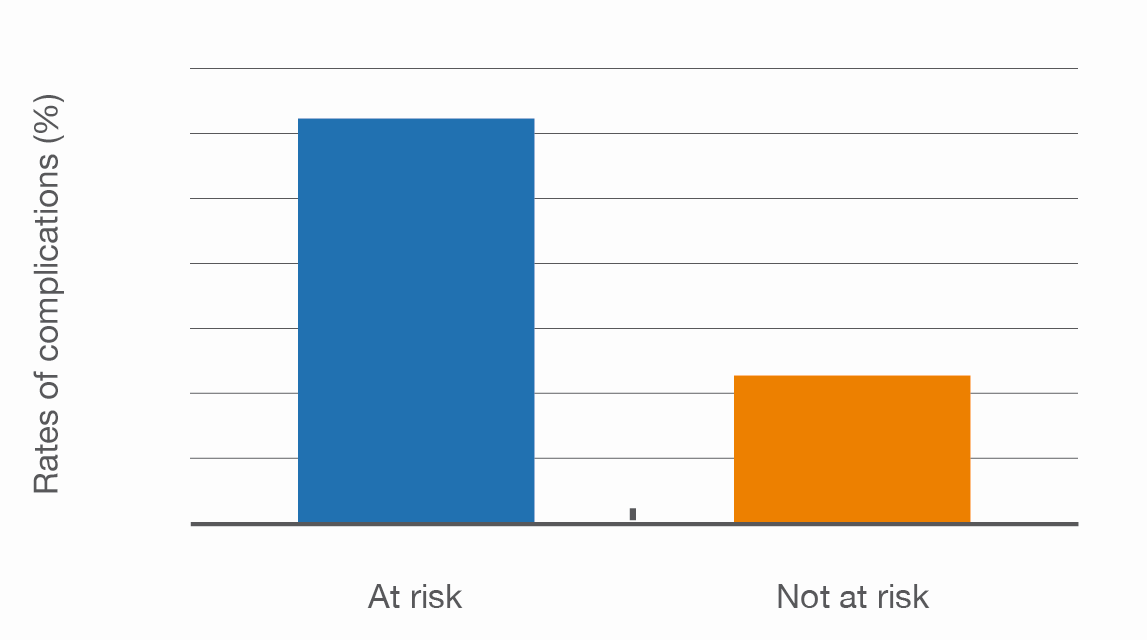
Figure 1.27
Increased rate of complications in at risk patients vs not at risk patients (p < 0.001) (adapted from Sorensen et al. 2008)299
- Older women with weight loss have increased rates of hip bone loss and the risk of subsequent hip fracture is twice greater.308
 Malnutrition may affect the ability to withstand cancer treatment
- Nutritional risk (using NRS-2002) has been shown to be an independent predictor of postoperative complications in colorectal cancer patients.309
- Malnutrition has similar effects on patients with cancer as it has on patients without cancer, such as effects on GI integrity, adverse impact on respiratory and cardiac muscle function, recovery from surgery, wound healing, psychological and immune function.
- Treatment effects may also contribute, including the use of chemotherapy agents, irradiation and immunosuppressive medications, and surgery. Studies have demonstrated that malnourished patients receiving chemotherapy have more pronounced treatment-related side effects and breaks from treatment to manage these, e.g. stomatitis.310
- Malnutrition in cancer is associated with poor response to therapy, increased susceptibility to treatment-related adverse events, as well as poor outcome and QOL.311
- A study analysed the relationship between low muscle mass, malnutrition, sarcopenia, and survival in 4,122 cancer patients from the UK Biobank, and found that malnutrition was more prevalent than sarcopenia, with both conditions associated with an increased risk of mortality.296
- A review on the prevalence and impact of malnutrition, cachexia, and sarcopenia across various cancer types and treatment settings found that pancreatic, oesophageal, and other gastroenteric cancers, head and neck, and lung cancers had the highest rates of malnutrition. Advanced-stage cancer further contributed to nutritional deterioration .285
- Malnutrition in older patients with gastrointestinal cancer undergoing chemotherapy is influenced by risk factors such as low BMI, gastroesophageal cancer, palliative chemotherapy, and frailty.295 Advanced age, frailty, dementia, and functional impairment also contribute to malnutrition in older cancer patients, which is independently associated with poor survival, longer hospital stays, and increased healthcare costs.286 Malnutrition, sarcopenia, and cachexia in gynaecologic cancer worsen treatment outcomes and increase healthcare costs. Metabolic and inflammatory changes contribute to muscle loss, and while nutritional and exercise interventions may help, more clinical trials are needed to develop effective management strategies.312
- Cancer-related malnutrition involves systemic inflammation, metabolic disruptions, and muscle wasting, making weight loss alone insufficient for diagnosis. Diagnostic imaging was recommended for muscle depletion assessment.313
- Integrating GLIM criteria into routine clinical nutritional assessments can improve the accuracy of malnutrition diagnosis in oncology settings314. However, the standard GLIM criteria may not fully capture the role of systemic inflammation in cancer-related malnutrition. Xie et al. (2023) explored the use of systemic inflammation markers, such as C-reactive protein (CRP) and neutrophil-to-lymphocyte ratio (NLR), as supplements to the GLIM criteria. Their findings demonstrated that inflammation marker-based GLIM criteria provided better prognostic accuracy and were independent predictors of long-term outcomes.315 Incorporating inflammatory markers into malnutrition assessments may further refine diagnostic precision and improve survival prediction in cancer patients.315
- Early nutritional screening and personalised interventions were recommended to improve treatment adherence, quality of life, and overall survival in cancer patients. Implementing timely nutritional assessments and targeted interventions can help mitigate the adverse effects of malnutrition, enhance treatment tolerance, and ultimately improve patient outcomes.285,297
 Malnutrition is associated with increased morbidity in children
- In a study of children aged 31 days to 17.9 years (n = 175) who required major abdominal or non-cardiac thoracic surgery on a non-emergency basis, malnourished children had a higher rate of infectious complications compared to well-nourished children (p = 0.042). 41
- A prospective cohort study of 385 children admitted to a tertiary paediatric intensive care unit at a teaching hospital in Brazil found that malnutrition on admission (using z-score of WFA in infants < 2 years of age and z-score of BMI in children aged ≥ 2 years based on WHO child growth standard curves) was associated with greater length of mechanical ventilation in a multiple logistic regression model (OR 1.76, 95%; CI 1.08–2.88, p = 0.024).316
- A review by Franke and colleagues examined malnutrition screening and treatment in paediatric oncology, including nine studies. The authors found that, although a range of malnutrition outcomes, interventions, and screening tools were used, nutritional interventions were generally effective in promoting weight gain and reducing complications. Screening tools helped to lower the risk of malnutrition and may support improved weight gain.317
- A prospective study of children aged 1–18 years newly diagnosed with cancer in low income countries in Central America showed that frequency of abandonment of therapy was related to degree of malnutrition (using percentile BMI for age, MUAC, TSFT and albumin) (6.1% vs 12.5% vs 14.0% for adequately nourished, moderately depleted and severely depleted children respectively [total 11.9%, p < 0.001]).306
Malnutrition has an adverse impact on growth and development in children
- Poor weight gain or weight loss is one of the first indicators of malnutrition in children with acute malnutrition presenting with decreased WFH but normal HFA.318
- Nutritional imbalances that are sustained for any appreciable length of time adversely affect growth in terms of height.318
- Development is rapid in childhood, particularly in early childhood, and adverse effects of malnutrition on learning, behaviour and cognition in children have been described.53
- A review and meta-analysis showed that failure to thrive in infancy is associated with adverse cognitive outcomes in children identified in primary care (pooled effect size weighted standardised mean difference -0.30; 95% CI -0.18 to -0.42) and in children identified in hospital or specialist clinics (-0.85; 95% CI -0.41 to -1.30). The large difference in effect size may be related to the fact that cases with more developmental delay are more likely to be referred to hospitals or specialist clinics.319
- A small-scale study (n = 20, age groups 5–7 years and 8–10 years) from India designed to investigate the effect of stunting and/or wasting (as a result of chronic protein-energy malnutrition) on the nature of cognitive development and the rate of cognitive development found that malnourished children performed poorly compared with well-nourished children in tests of cognitive flexibility, attention, working memory, visual perception, verbal comprehension and memory. Stunting in particular may be responsible for the lack of age-related improvement in malnourished children for tests of design fluency, working memory, visual construction, learning or memory.320
- Early infancy may be a critical period for the effect of under-nutrition on cognitive development. The Avon Longitudinal Study of Parents and Children (ALSPAC) in the UK (n = 5771) found that early growth faltering (defined as < 5th percentile for weight gain in the first 8 weeks) was associated with a total intelligence quotient (IQ) that was significantly lower by an average of -2.71 points at 8 years of age.321
- Infants (n = 130) with faltering growth (defined as sustained WFA < 5th percentile or weight-for-length < 10th percentile) recruited from primary care clinics in low-income urban areas in the US were compared with infants with adequate growth and were shown to be more vulnerable to short stature, poor arithmetic performance and poor work habits at 8 years of age, illustrating the possible longer-term effects of early failure to thrive, although other factors could be involved.322
- Chronic malnutrition leads to growth failure, with stunting and wasting directly correlated to infection risk and long-term developmental deficits.323