
3.2.4 Clinical benefits of ETF
3.2.4.1 MORTALITY
 ETF can reduce mortality rates in hospital patients
- According to Cho et al., 202461 early EN introduction (within 48 hours of ICU admission) was associated with a 42% decrease in mortality (adjusted OR = 0.58, 95% CI = 0.34–0.98; p = 0.045). Additionally, a 58% decrease in mortality rate was linked to rapid EN progression in patients who received early EN initiation in subgroup analysis (adjusted OR = 0.42, 95% CI = 0.18–0.95; p = 0.039).
- In a multicentre ICU trial by Landais et al. 202363, patients who continued enteral nutrition until extubation had a lower ICU mortality rate than those who fasted before extubation (3.9% vs. 6.8%; RR = 0.56, 95% CI: 0.32–0.99), suggesting a potential advantage.
- A systematic review by Stratton et al. found that mortality rates were significantly reduced by ETF compared with routine care in some patient groups. Mortality was significantly lower with ETF (11% vs. 23%) (Figure 3.48), with meta-analysis suggesting an odds ratio of 0.48 (95% CI 0.30–0.78). The reduction in mortality occurred to a similar extent in trials with a mean BMI <20kg/m² or >20kg/m². Weight change (+6-8% difference between ETF and control patients) was associated with improvements in mortality but there was no clear relationship with the duration of ETF.50
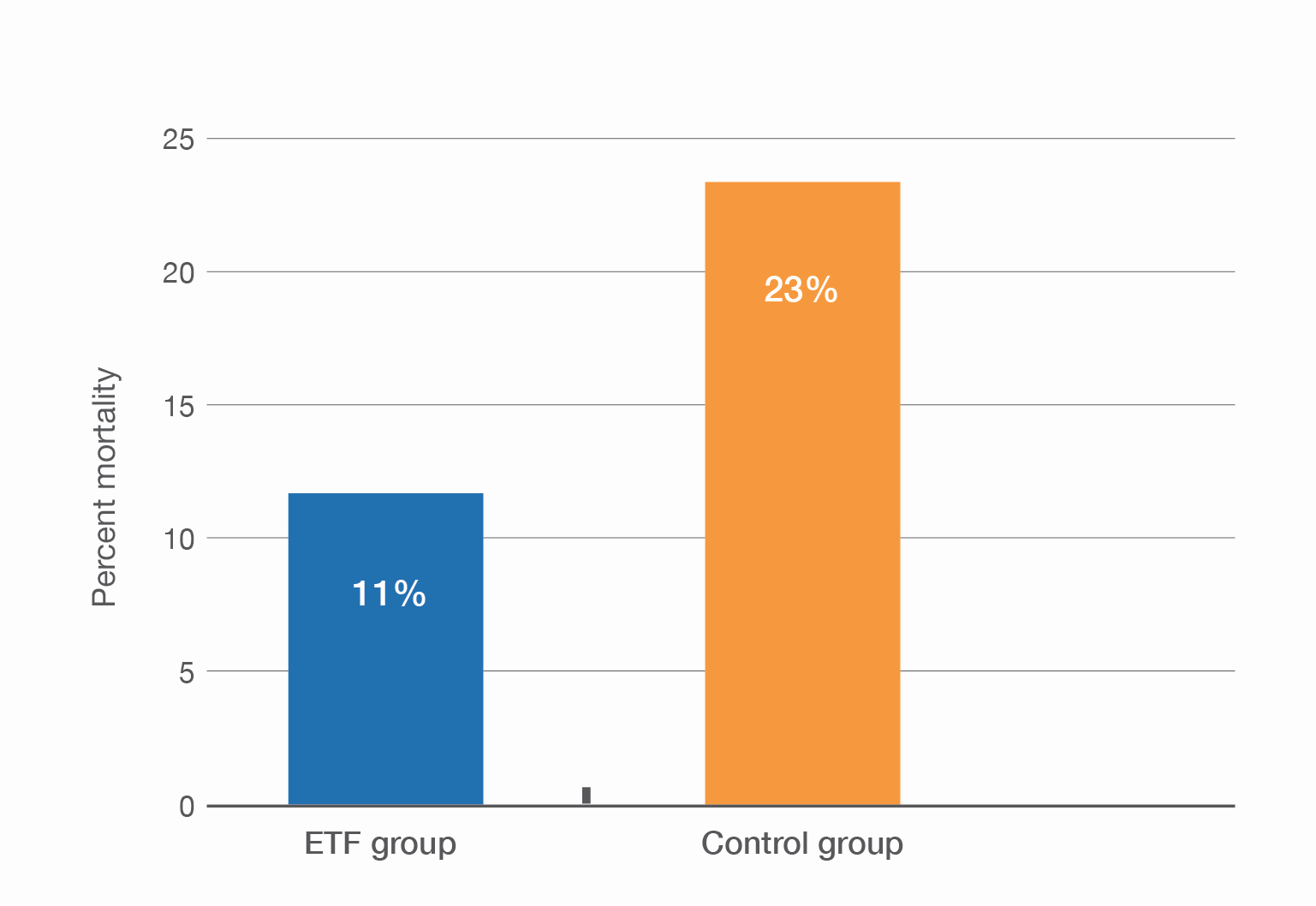
Figure 3.48
Lower mortality rates with ETF compared with routine clinical care (12 RCT, = 600) (adapted from Stratton et al. 2003)50
Early enteral nutrition may be associated with lower mortality in critically ill patients
- In formulating international guidelines on nutritional support therapy in adult critically ill patients, a meta-analysis of 21 studies was undertaken and showed that provision of early ETF was associated with a significant reduction in mortality (RR = 0.70; 95% CI, 0.49–1.00; p = 0.05) compared with withholding early ETF (delayed ETF or standard therapy) (see Figure 3.49).63
- Other meta-analyses have made similar conclusions based on mortality outcomes but patient groups included and definitions of early enteral nutrition vary between studies (see Table 3.9).
- Moreover, according to Cho et al., rapid advancement of enteral nutrition (EN) within the first 7 days, defined by a greater increase in EN volume, was associated with a 25-day shorter hospital stay (95% CI = −41 to −9.2; p = 0.002) and a 36% decrease in in-hospital mortality (adjusted OR = 0.64, 95% CI = 0.38–1.07; p = 0.092).61
- On the other hand, other meta-analyses showed that although, compared to delayed EN, early EN held several benefits such as improved clinical outcomes, reduced complications, length of hospital stay, antibiotic days, and ICU stays, there was no significant difference in mortality between early and delayed EN. (See Table 3.9)
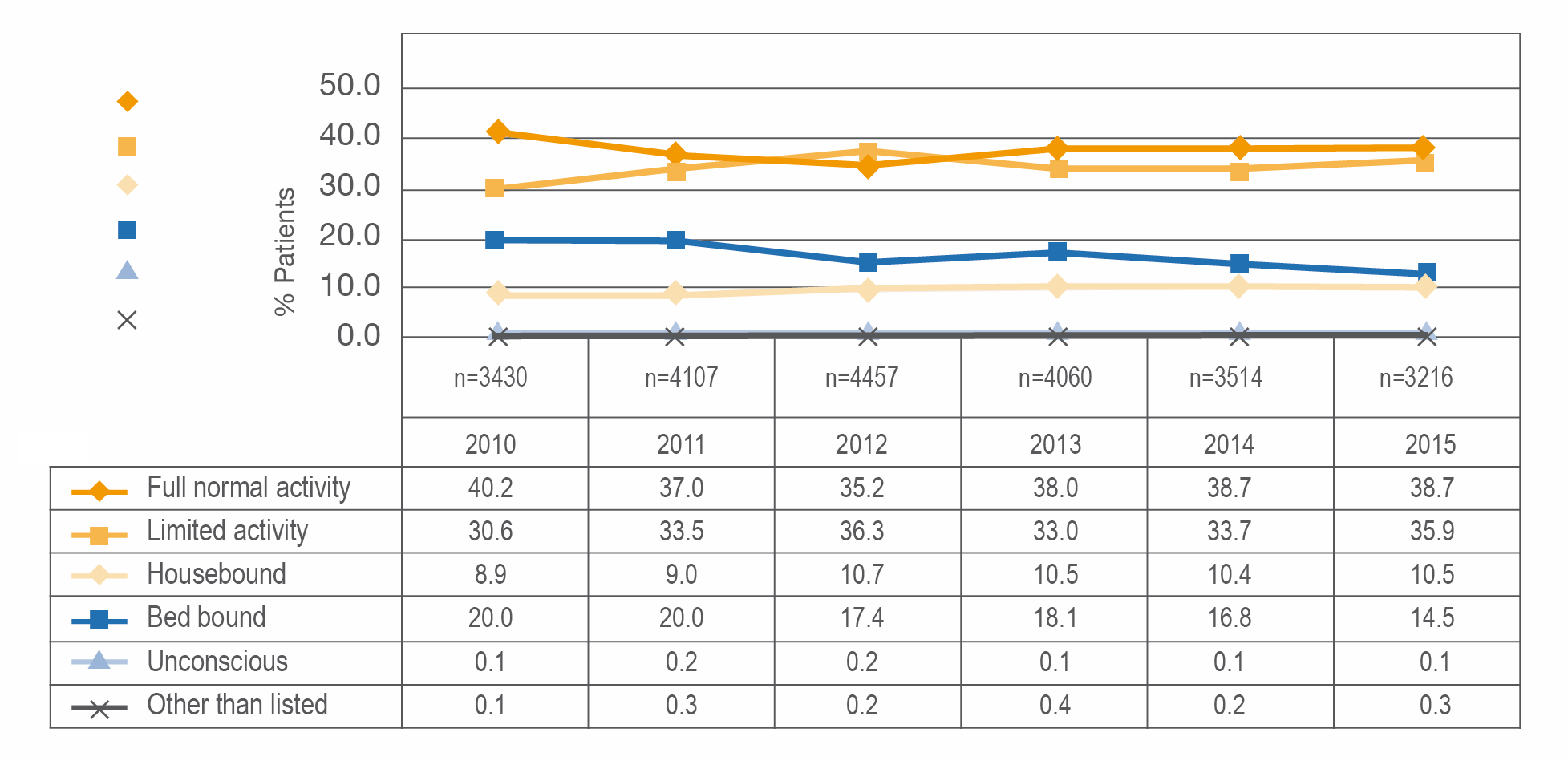
Figure 3.49
Early Enteral Nutrition (ENN) vs. Delayed enteral nutrition (DEN) associated with a reduced risk of mortality (adapted from McClave et al. 2016)63
Table 3.9
Overview of meta-analyses looking at timing of enteral nutrition with respect to mortality as an outcome
| Author (year) | Type of study (no. of RCTS) | Patient group | EEN definition | Outcome mortality |
|---|---|---|---|---|
| McClave et al. (2016)63 | Meta-analysis (n = 21) | Not reported | Not reported | EEN was associated with a significant reduction in mortality (RR = 0.70; 95% CI, 0.49–1.00; p = 0.05) compared with withholding early EN (delayed EN or standard therapy) |
| Li et al. (2014)64 | Meta-analysis (n = 12 RCTs, 625 subjects) | Acute pancreatitis | Within 24 hrs of admission | EEN was associated with a lower mortality rate (16/300 vs. 36/323) (RR: 0.51, 95% CI: 0.30–0.86, p = 0.01, I2 = 34%) compared to TPN or delayed enteral nutrition (DEN) |
| Li et al. (2013)65 | Meta-analysis (n = 11RCTs, 775 subjects) | Acute pancreatitis | Within 48 hours of admission | EEN was associated with a significant reduction in mortality (OR 0.31; 95%CI 0.14–0.71, p <0.05) |
| Wang et al. (2013)58 | Meta-analysis (n = 5 RCTs and 3NPSs) | Traumatic brain injury | Within 72 hours of admission (5 studies) and within 7 days post injury (2 studies) | EEN was associated with a significant reduction in the rate of mortality (relative risk [RR] = 0.35; 95% CI, 0.24–0.50) p = 0.05; I2 = 44%) compared to delayed feeding |
| Doig et al. (2011)66 | Meta-analysis (n = 3 RCTs 126 subjects) | Adult trauma patients in intensive care | Within 24 hours of injury | EEN associated with a significant reduction in mortality (OR = 0.20, 95% confidence interval 0.04–0.91, p = 0.04, I2 = 0) |
| Baik et al. (2025)67 | Meta-analysis (n = 14 studies, 7,618 patients) | Critically ill patients | Within 24 hours of ICU admission | No significant difference in mortality between early EN and early parenteral nutrition (EPN) (OR = 1.03, 95% CI = 0.93–1.14, P = 0.58). However, early EN was linked to reduced bloodstream infections and shorter ICU and hospital stays. |
| Pu et al. (2018)68 | Meta-analysis (n = 7 RCTs, 527 patients) | Major burn injury | Within 24 hours of injury or ICU admission | Early EN was associated with a significantly reduced mortality (OR = 0.36, 95% CI = 0.18–0.72, P = 0.003). Early EN also reduced sepsis, pneumonia, renal failure, gastrointestinal haemorrhage, and shortened hospital stay by an average of 15.31 days. |
| Qi et al. (2018)69 | Meta-analysis (n = 8 studies, 727 patients) | Acute pancreatitis | Within 24 hours of admission | Early EN was associated with a significant reduction in multiple organ failure (OR = 0.40, 95% CI = 0.20–0.79, p = 0.008). However, no significant difference in mortality between early EN and late EN or TPN (OR = 0.56, 95% CI = 0.23–1.34, p = 0.19). |
| Zheng et al. (2019)70 | Meta-analysis (17 RCTs) | Critically ill adult patients (post-op, trauma, ICU, pancreatitis, TBI, etc.) | Enteral nutrition initiated within 48 h of ICU admission or surgery | Early EN significantly reduced overall complications, infectious complications, pneumonia, and hospital length of stay compared to delayed EN, although no significant difference in mortality was observed (RR = 0.86, 95% CI: 0.60–1.23; p= 0.42). |
| Ebaed et al. (2025)71 | Meta-analysis (18 RCTs) | Critically ill adult patients (ICU, post-op, trauma, sepsis, TBI, etc.) | Enteral nutrition initiated within 48 h of ICU admission or surgery | Early EN significantly reduced infectious complications, mechanical ventilation days, ICU length of stay, and severity scores (SOFA, APACHE II). However, no significant difference in mortality was observed between early and delayed EN (RR = 0.86, 95% CI: 0.70–1.05; p = 0.14) |
CI Confidence interval; DEN delayed enteral nutrition EEN Early enteral nutrition; EN enteral nutrition; NPSs non-randomized prospective studies; RCTs Randomised controlled trials TPN Total parenteral nutrition
Early enteral nutrition improves clinical outcomes and reduces complications in critically ill patients, reinforcing its importance in nutritional support despite variability in mortality impact across studies.
Higher energy and protein intakes in critically ill septic patients over the course of their ICU stay are associated with a lower 60-day mortality
- In a secondary analysis of pooled data collected prospectively from international nutrition studies (n = 2,270) in critically ill septic patients with a median length of ICU stay of 11 days, receiving total enteral tube feeding, an increase in energy intake via ETF of 1,000 kcal was associated with reduced 60-day mortality (odds ratio (OR) 0.61; 95% confidence interval (CI) 0.48 to 0.77, p <0.001). An increase of 30g protein delivered by ETF was also associated with a reduced 60-day mortality (OR 0.76; 95% CI 0.65 to 0.87, p <0.001).72
- The same analysis showed that the lowest tertile of energy and protein intake received per day (patients receiving ≤865 kcal/d and ≤39.5 g/d, respectively) was associated with increased 60-day mortality as compared to the highest tertile (patients receiving ≥1,294 kcal/d and ≥58.9 g/d, respectively).72